Views: 0 Author: Site Editor Publish Time: 2026-09-04 Origin: Site
How to take N-acetyl cysteine starts with the label on the specific supplement you have—not with a generic NAC dose found online.
Read the serving size and NAC amount in Supplement Facts, then read the product's directions for frequency, food or timing instructions. Check the dosage form, Other Ingredients, cautions and storage information before use. If the label is unclear or medicines or health conditions affect the decision, ask a pharmacist or clinician.
N-acetyl cysteine, commonly shortened to NAC, is sold in several oral supplement formats, including NAC capsules, softgels and powders. That makes the search question how to take N-acetyl cysteine more complicated than it first appears: two products can use the same ingredient name while having different serving sizes, different amounts per serving, different dosage forms and different supplement directions.
The practical solution is not to memorize one universal NAC schedule. It is to learn how to read the finished label correctly and then use that information to answer the food, timing, dosage-form and missed-serving questions for the product you actually have.
This process prevents the most common mistake with NAC supplements: treating a milligram number as if it were the complete instruction. A number such as NAC 600 mg only becomes useful when you know what serving basis it belongs to and how the finished product tells you to use that serving.
The original workflow draft was right to make the label central, but one distinction matters: not everything you need appears inside the Supplement Facts panel. For U.S. dietary supplements, Supplement Facts carries the serving information and dietary-ingredient declarations. Directions, the ingredient statement, net quantity, cautions and storage information appear elsewhere on the label as applicable.
Serving Size — the labeled amount used as one serving basis.
Servings Per Container — shown when required.
Dietary ingredient name — where NAC is identified as a dietary ingredient.
Amount per serving — the quantitative amount declared for the serving.
Directions / Suggested Use — frequency and any product-specific use instruction.
Other Ingredients / ingredient statement — non-dietary ingredients such as relevant shell or carrier components.
Net quantity / dosage form — how the finished product is presented.
Cautions and storage — product-specific handling and safety information where provided.
FDA's dietary-supplement labeling guidance states that Supplement Facts includes the names and quantities of dietary ingredients, Serving Size and, when applicable, Servings Per Container. That is why a consumer should not expect storage directions or the complete ingredient statement to appear as rows inside Supplement Facts. Review FDA's Supplement Facts labeling guide.
The phrase NAC 600 mg is common in this category, but it should never be used as a shortcut for the complete supplement directions. On a finished U.S. supplement label, the declared NAC quantity has to be read together with the serving basis shown in Supplement Facts.
Do not work backward from a front-label or product-page number to estimate the contents of each individual capsule or softgel. If the label says a serving contains two capsules and declares a certain amount of NAC per serving, use the label's serving statement as written; do not invent a per-capsule instruction that the label does not provide.
Acetylcysteine is also used in regulated drug products in medical settings. Those products can use different routes of administration and condition-specific protocols. A prescription, inhaled or hospital-use acetylcysteine regimen is therefore not a template for how to take an over-the-counter NAC supplement.
Use the serving information and directions on the specific finished supplement, with professional guidance when individual medical factors apply.
Follow the prescribing information and clinician's instructions for that drug product and clinical use.
Keeping those two contexts separate prevents drug dosing, disease indications or clinical treatment schedules from being transferred to a consumer supplement.
Food and NAC timing are legitimate consumer questions, but they do not have one universal answer for every finished supplement. The label should come first. If the product specifies a meal context, frequency or timing instruction, use that product-specific direction unless a qualified healthcare professional advises otherwise.
| Question | Practical answer | Avoid this shortcut |
|---|---|---|
| NAC with food? | Follow the finished label. If it is silent and you have tolerability questions, ask a pharmacist or clinician about the specific product. | Do not assume every NAC product is better on an empty stomach or with a fatty meal. |
| Morning or evening? | When the label gives no clock time, there is no well-established universal rule that one time is superior for general supplement use. | Do not turn a research schedule into a personal supplement regimen. |
| One serving or divided? | Use the serving pattern stated on the finished label. | Do not create an AM/PM split from a generic NAC recommendation. |
This article keeps timing intentionally concise because “when is the best time to take NAC?” is a separate information need from “how to take NAC.” Here, the useful principle is simply to avoid overriding the finished label with an unsupported universal rule.
Dosage form changes how a supplement is handled, but the shell type alone does not prove that one NAC supplement will be more effective than another. The useful differences for a consumer are the physical format, the serving configuration and the product-specific directions.
Softgels contain a compatible liquid, dispersion, suspension or similar fill inside a sealed shell. Follow the label for how the unit should be swallowed or otherwise used.
Do not open, chew, puncture or split a softgel unless that specific product is designed and labeled for such use.
Hard capsules commonly contain powder or granulated fills, although specialized fill systems also exist. Serving size and directions still come from the finished label.
Do not assume a capsule may be opened simply because another product allows it. Check the specific label or ask a pharmacist.
For readers comparing formats rather than use instructions, MINGYAN's softgel manufacturing range and capsule manufacturing range show the two dosage-form paths separately.
Once you understand the label, most remaining questions are practical rather than biochemical. The safest way to handle them is to keep the finished product—not a generic NAC rule—at the center of the decision.
Ask a qualified clinician or pharmacist before using NAC when prescription medicines, pregnancy or breastfeeding, an ongoing medical condition, use in a child, a planned procedure, or an unexpected reaction makes the decision individual rather than general.
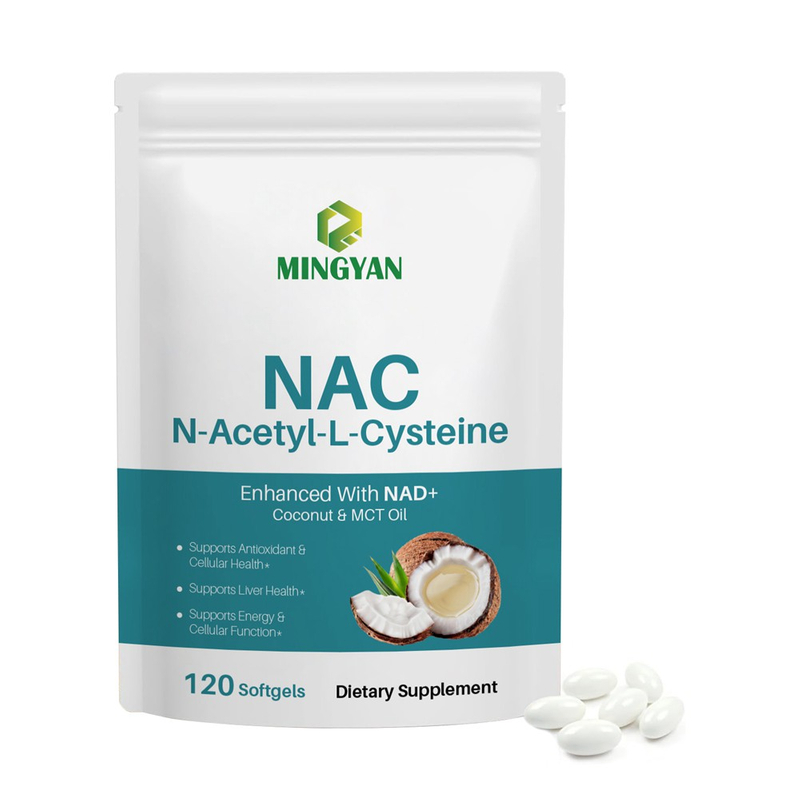
Our current NAC softgel is useful for showing why dosage form, formula strength and serving instructions must remain separate concepts.
The presence of coconut oil or MCT oil does not create a universal meal-timing rule. It is a formulation characteristic. The approved commercial label—not the carrier alone—should define how the finished product is used.
For brands developing an NAC supplement, “how to take NAC” becomes a specification and labeling question before it becomes consumer copy. The formula, dosage form, serving basis and intended directions need to agree with one another.
Brands defining an NAC 600 mg concept can go deeper into sourcing and specification questions in our NAC 600 mg sourcing guide.
Start by reading the full product label. Confirm Serving Size and the NAC amount in Supplement Facts, then read the directions, Other Ingredients, cautions and storage information. Use the product as labeled rather than selecting a dose or schedule from a different NAC product.
There is no universal meal rule that applies to every NAC supplement. Follow the directions on the specific finished product. If the label is silent and you have tolerability or medication questions, ask a pharmacist or clinician rather than assuming that “with food” or “empty stomach” is always better.
For general supplement use, no single morning or evening time has been established as universally best. If the label specifies timing, follow it. If it does not, avoid treating an unrelated clinical or research schedule as a personal instruction.
Not automatically. A 600 mg statement needs a defined serving basis. Check the Supplement Facts panel on the finished product. MINGYAN's current public NAC product uses “600 mg formula option” wording and does not by itself establish a per-softgel or per-serving basis.
Do not open, puncture, chew or split a softgel unless that specific product is designed and labeled for that use. If swallowing the dosage form is difficult, ask a pharmacist about an appropriate alternative.
Check the product's directions first. If they do not address a forgotten serving, ask a pharmacist or clinician for guidance on that specific product. A generic missed-dose rule should not be invented for all NAC supplements.
Use the frequency and duration stated for the finished product. If long-term use, prescription medicines or a medical condition are part of the decision, discuss the specific supplement with a qualified healthcare professional.
The most reliable answer to how to take N-acetyl cysteine is not a universal milligram amount, meal rule or clock time. It is a repeatable label-reading process: identify the dosage form, read Serving Size, confirm the NAC amount per serving, follow the finished product's directions, and then check the remaining ingredient, caution and storage information.
That approach also keeps NAC 600 mg claims in context. A strength statement does not automatically tell you the number of capsules or softgels to take, and MINGYAN's public 600 mg NAC formula option should not be converted into a per-softgel or per-serving claim without the approved specification.
When medicines, health conditions, pregnancy or breastfeeding, use in children, a missed serving or an unexpected reaction makes the answer personal, the correct next step is a pharmacist or clinician—not a generic supplement rule from another product.