

Views: 0 Author: Site Editor Publish Time: 2026-08-28 Origin: Site
A NAC 600 mg capsule may appear to be a simple product specification: one ingredient, one strength, and one dosage form. In practice, however, “600 mg NAC” alone is not enough to define a manufacturable capsule, an approvable finished-product specification, or a truly comparable supplier quotation.
Before requesting pricing, supplement brands should define what the 600 mg claim means, which N-Acetyl-L-Cysteine specification will be used, how raw-material assay relates to the target active quantity, whether the total powder blend can fit an acceptable capsule format, how serving size will be declared, which quality documents and verification controls are required, and how the finished product will be packaged and supported throughout its intended shelf life.
For a conventional hard-capsule project, the practical development sequence is not simply “NAC → 600 mg → capsule.” A more useful sequence is ingredient specification → formula composition → physical properties → fill-volume feasibility → capsule size → serving configuration → finished-product specification → packaging and release requirements.
A brand should not finalize capsule size, Supplement Facts, packaging count, or a quotation until the NAC amount per dosage unit, units per serving, raw-material assay basis, total blend composition, and finished-product specification have been clearly defined.
NAC is the common abbreviation for N-Acetyl-L-Cysteine, also known as acetylcysteine. From a sourcing perspective, confirming chemical identity is only the first step. The commercial specification must also define how much NAC is intended to be present in the finished product and how that amount will be declared on the label.
For a U.S.-market dietary supplement, the Supplement Facts panel declares dietary ingredient quantity on a per-serving basis. Serving size is therefore directly connected to the product specification. A 600 mg NAC concept could represent one capsule per serving or a multi-capsule serving, depending on the approved formulation and label directions.
Buyers should distinguish the following values instead of treating them as interchangeable:
| Specification Element | What It Means | Why It Matters |
|---|---|---|
| NAC declared amount | The intended dietary ingredient quantity associated with the labeled serving. | This is the consumer-facing strength declaration, not automatically the total powder or finished-capsule weight. |
| Raw-material assay basis | The basis on which the incoming NAC material is characterized and its assay is reported. | The approved manufacturing formula should connect the incoming material specification to the intended active quantity. |
| Target active quantity per capsule | The intended amount of NAC delivered by each dosage unit. | This helps determine whether one capsule or multiple capsules are needed per serving. |
| Total powder blend weight | NAC-containing raw material plus other active ingredients and formulation excipients inside the capsule. | This value may be materially higher than the NAC declaration. |
| Capsule shell weight | The mass of the empty shell. | It contributes to gross finished-capsule weight but is not part of the declared NAC amount. |
| Gross finished capsule weight | Powder fill plus capsule shell. | It should not be confused with active strength or fill weight alone. |
| Dosage units per serving | The number of capsules corresponding to the labeled serving. | It connects formulation feasibility with Supplement Facts and directions for use. |
| Units per package | The commercial capsule count in the bottle, pouch, or other package. | It affects servings per container, packaging cost, label layout, and quotation comparability. |
The key sourcing point is that 600 mg active ingredient does not automatically mean 600 mg total fill weight, and neither value determines capsule size by itself.
It may be feasible, but the answer cannot be determined from the front-label number alone. Capsule feasibility is a volume problem as well as a mass problem.
As a first engineering approximation, the space required by a powder blend is related to total blend mass and its effective packing density:
This relationship is useful for feasibility screening, but actual capsule-filling performance also depends on powder flow, packing behavior, particle characteristics, formulation composition, equipment, and the required fill-weight consistency.
Two powder blends can have the same mass while occupying very different volumes. Bulk density therefore matters when estimating whether the complete NAC formulation can fit into a target capsule. A relatively low-density blend can require substantially more capsule volume than a denser blend at the same fill weight.
Tapped density can provide additional information about how a powder packs under mechanical movement, but neither bulk density nor tapped density alone predicts commercial capsule-filling performance. The final formulation still needs to be evaluated as a processable blend.
Commercial capsule filling repeatedly meters powder into individual shells. If the blend does not flow and replenish consistently, maintaining stable fill weights can become more difficult. Flowability is therefore not simply a production convenience; it is part of determining whether the intended formula can be filled reproducibly at commercial scale.
Particle size distribution, morphology, density differences between ingredients, and cohesive behavior can influence flow, packing, segregation risk, and blend uniformity. A multi-ingredient formula containing materials with substantially different physical properties should therefore be evaluated as a complete blend rather than assuming each ingredient will behave independently.
Depending on the formulation, excipients may be needed to support flow, processing, fill consistency, or other manufacturing requirements. These materials contribute additional mass and volume. As a result, a request for “600 mg NAC per capsule” should not assume that the total powder fill will also be 600 mg.
If the formula contains NAC together with vitamins, minerals, botanicals, or other dietary ingredients, those materials increase total blend mass and can also change density, flowability, particle distribution, moisture behavior, and practical fill volume.
It is therefore not technically sound to state that 600 mg NAC always requires a specific capsule size. The same nominal NAC strength can lead to different capsule-size decisions depending on raw-material properties, excipients, additional actives, fill behavior, and serving configuration.
If the preferred single-capsule concept creates an impractical capsule size or poor filling behavior, the formulation or serving configuration can be reassessed rather than forcing the product into an unsuitable dosage unit.
For our private label capsule manufacturing projects, capsule size, powder density, fill weight, flowability, ingredient volume, and serving requirements are evaluated together rather than treating capsule size as a fixed decision based only on the front-label strength.
NAC sourcing should not be reduced to asking whether a supplier “has NAC” or whether a COA is available. N-Acetyl-L-Cysteine has a defined chemical identity and recognized compendial references, but the actual purchasing specification still needs to be defined for the commercial project.
The USP-NF Acetylcysteine monograph provides a recognized compendial reference for acetylcysteine, including identity and assay requirements as well as references to related compounds. This does not mean that every commercial NAC ingredient automatically meets USP-NF requirements, nor should a compendial reference be treated as evidence of the actual specification used for a specific project.
Brands should determine whether NAC will be purchased against a recognized compendial specification, a raw-material manufacturer's specification, or a project-specific approved specification. The chosen specification should define the applicable identity, assay basis, related-substance or impurity controls, contamination criteria, storage conditions, and other acceptance requirements relevant to the ingredient and intended market.
Identity: Is the incoming material unambiguously specified as the intended N-Acetyl-L-Cysteine / acetylcysteine material?
Assay: What assay range applies, and on what basis is the result reported?
Related substances: Which related compounds or degradation-related impurities are controlled under the selected specification?
Applicable contaminants: Which chemical, elemental, microbiological, or other contamination criteria are appropriate for the ingredient, manufacturing process, and destination market?
Traceability: Is the lot traceable through the raw-material supplier and relevant manufacturing documentation?
Storage: What storage conditions apply before the material enters production?
Specification changes: How will changes in source, specification, analytical method, or other material characteristics be communicated and evaluated?
A 600 mg label target should not automatically be translated into “weigh 600 mg of raw material.” The raw-material specification and assay basis need to be connected to the approved manufacturing formula and the intended active quantity in the finished product.
For a well-defined project, the incoming NAC specification, approved formula, manufacturing controls, and finished-product strength specification should connect logically. The exact calculation and production approach should be defined within the manufacturer's controlled formulation and production documentation rather than assumed from the front-label claim.
NAC contains a thiol functional group and can participate in oxidation chemistry. Published acetylcysteine stability research has demonstrated oxygen-dependent formation of oxidized products in certain liquid systems, while compendial references also recognize acetylcysteine-related compounds.
These observations do not establish the degradation profile or shelf life of a specific dietary supplement capsule. They do explain why a technically serious NAC raw-material specification should address identity, assay, relevant related substances, storage, and stability rather than treating NAC powder as a chemically featureless commodity.
A professional n acetyl cysteine 600 mg capsule development process should connect each engineering variable to the next decision rather than treating formulation, capsule size, serving size, and packaging as separate tasks.
The first step is to define the NAC material, assay basis, target active amount, allowable formulation components, and intended serving configuration. If additional dietary ingredients are included, they should be considered at this stage rather than added after capsule size has already been selected.
The capsule-filling process handles the entire formulation, not only the NAC label claim. NAC-containing raw material, additional active ingredients, and formulation excipients together determine the target fill weight and physical behavior of the material entering encapsulation.
Bulk density helps estimate required volume. Tapped density provides information about packing behavior. Flowability affects transfer and dosing consistency. Particle characteristics can influence flow, blend homogeneity, segregation, and fill performance. These variables should be evaluated using the actual or representative commercial formulation.
Once the complete formulation has been defined, the required fill volume can be compared with practical capsule options and manufacturing requirements. This is the stage at which capsule size becomes an engineering decision instead of a marketing preference.
If one capsule would create an undesirable dosage-unit size or manufacturing constraint, a multi-capsule serving may be evaluated. That decision then affects Supplement Facts, directions for use, package count, servings per container, packaging dimensions, and commercial positioning.
The finished-product specification should describe the actual finished dosage form rather than simply repeating the raw-material COA. For U.S.-market manufacturing subject to 21 CFR Part 111, finished-product specifications address identity, purity, strength, composition, and applicable contamination limits. Packaging and labeling specifications also form part of the controlled product definition.
“NAC 600 mg, 60 capsules, quote please” leaves most of the technical specification unresolved.
A comparable quotation should define at least the active-strength basis, serving configuration, complete formula scope, capsule-shell requirement if applicable, package count, packaging format, destination market, quality-document expectations, label responsibility, and required testing or claim-support needs.
For U.S.-market dietary supplements, 21 CFR Part 111 provides a useful framework for understanding why a COA alone is not a complete quality system.
Under 21 CFR 111.70, manufacturers establish component specifications, including identity and specifications necessary to ensure finished-product purity, strength, and composition, together with applicable contamination limits. The regulation also addresses finished-product specifications and specifications for packaging and labeling.
Under 21 CFR 111.75, manufacturers subject to the rule must conduct at least one appropriate test or examination to verify the identity of each dietary ingredient before use unless the specified FDA exemption applies. The same section also establishes conditions under which a manufacturer may rely on a supplier's certificate of analysis for certain component specifications.
Supplier COA reliance under the rule is tied to supplier qualification, confirmation of COA reliability, documentation, periodic reconfirmation, and quality-control review. The practical implication for procurement is that a supplier COA is evidence within a controlled specification and verification system; it is not a substitute for that system.
A supplement brand conducting supplier qualification does not normally need access to every confidential formulation record or every internal controlled document. More useful due-diligence questions concern how specifications are approved, how dietary ingredient identity is verified, how suppliers are qualified, how deviations and changes are managed, what finished-product verification is performed, how batch documentation is reviewed, who has release authority, and how lot traceability is maintained.
The document request should be organized according to its purpose. Asking for “all certificates” usually produces less useful information than identifying what evidence is required for raw-material review, finished-product approval, and quality-system qualification.
For the NAC component, buyers should define and request the approved raw-material specification, lot-specific raw-material COA, identity information, assay specification and basis, applicable related-substance or impurity criteria, relevant contaminant documentation, supplier or source information appropriate to the project, traceability information, and stated storage requirements.
If a compendial designation is requested, the purchasing specification should clearly identify the required standard and what evidence demonstrates conformance. The existence of the USP-NF Acetylcysteine monograph should not be converted into an unsupported assumption that every NAC raw material used in a private label project is USP grade.
The finished product requires its own approved specification. This should define the dosage form, serving configuration, NAC strength, composition requirements, relevant physical or quality attributes, applicable contamination criteria, packaging configuration, labeling specification, and other release criteria appropriate to the project.
For commercial supplier qualification, a brand may also request a lot-specific finished-product COA or equivalent controlled release document showing results relevant to the approved finished-product specification. A raw-material COA alone does not demonstrate that the completed NAC capsule meets its finished-product requirements.
Procurement teams should also understand the system surrounding the documents: specification approval, incoming-component controls, supplier qualification, in-process controls, scientifically valid testing or examination where applicable, batch-record review, deviation handling, finished-product release, change control, and traceability.
A commercial quality agreement or responsibility matrix can help clarify which party owns specifications, artwork approval, testing, label review, release decisions, change notification, complaints, and retained documentation. These agreements are quality-management tools and do not replace the regulatory responsibilities applicable to either party.
Our manufacturing, R&D, and quality capabilities are outlined in more detail on our company and manufacturing overview. Project-specific NAC specifications, testing requirements, documentation, and release criteria should still be confirmed for the final commercial product.
Raw-material stability does not establish finished-product shelf life. Once NAC is incorporated into a capsule blend, the stability question changes because the active ingredient is now interacting with other ingredients, the capsule shell, environmental exposure, and the selected container-closure system.
NAC's thiol chemistry makes oxidation a technically relevant consideration. Published acetylcysteine research has demonstrated oxygen-dependent oxidation behavior in certain formulated liquid systems, while other compatibility work has shown that acetylcysteine stability can vary with excipient environment and storage conditions.
These studies should not be used to assign a shelf life to a specific dietary supplement capsule. They support a more useful sourcing principle: finished-product stability is formulation- and package-specific.
A finished NAC capsule stability assessment may need to consider the complete formulation, dosage form, excipients, capsule shell, temperature, environmental moisture, oxygen exposure where relevant, light where relevant, storage conditions, container and closure, packaging barrier properties, and the attributes that must remain within specification throughout the intended shelf life.
For U.S. dietary supplements, FDA's dietary supplement CGMP requirements do not require a manufacturer to place an expiration or shelf-life date on the label. If a shelf-life, expiration, or “best if used by” date is used, appropriate supporting data should be available.
Do not ask only, “What is the shelf life?” Ask what data or technical rationale supports the proposed shelf-life statement for the final commercial formula in the final commercial packaging configuration.
Yes, because hard capsules and softgels represent different formulation and manufacturing pathways. Neither format is universally superior.
Conventional two-piece hard capsules are commonly used for suitable powders, granules, and dry blends. Their development emphasizes powder volume, density, flowability, blend behavior, fill weight, capsule size, shell selection, and serving configuration.
Softgels use a sealed shell around a liquid, solution, dispersion, suspension, or semisolid fill system. Development therefore shifts toward carrier selection, active loading, physical state of the ingredients in the fill, viscosity, dispersion stability, shell-fill compatibility, encapsulation behavior, and total fill volume.
| Development Question | Hard Capsule | Softgel |
|---|---|---|
| Primary fill system | Suitable dry powder, granule, or blend | Solution, dispersion, suspension, liquid, or semisolid system |
| Key physical variables | Bulk density, packing behavior, flowability, particle characteristics, blend uniformity | Solubility or dispersion state, particle behavior, sedimentation risk where relevant, viscosity, carrier compatibility |
| Dosage-unit feasibility | Total powder volume must fit the selected hard-capsule shell | Active ingredients plus carrier determine total fill volume and encapsulation requirements |
| Shell relationship | Shell selection follows formula volume, target-market, storage, and commercial requirements | Shell and internal fill must be evaluated as a compatible system |
| Main sourcing risk | Choosing capsule size from label strength without evaluating the complete blend | Assuming an oil-containing formula means every active is dissolved or automatically suitable for softgel processing |
If a project requires a different dosage-form pathway, you can also explore our private label softgel manufacturing capabilities.
An oil-containing softgel does not mean that every active ingredient in the formula is oil-soluble. Softgel fills can use different physical systems, including solutions, dispersions, suspensions, and semisolid systems. The actual state of each active needs to be determined from the final formula and development data.
This distinction becomes especially important when powder-type active ingredients are combined with oil carriers. During formulation development, the project team should confirm whether each active is dissolved, dispersed, or suspended; whether distribution remains sufficiently uniform; whether particle behavior or sedimentation creates a consistency risk; whether the fill viscosity is appropriate for the intended process; whether the required active loading is feasible; and whether the fill system is compatible with the softgel shell.
Unit-to-unit consistency, physical stability of the fill, finished-product stability, manufacturing repeatability, and packaging suitability should also be evaluated for the actual commercial formula.
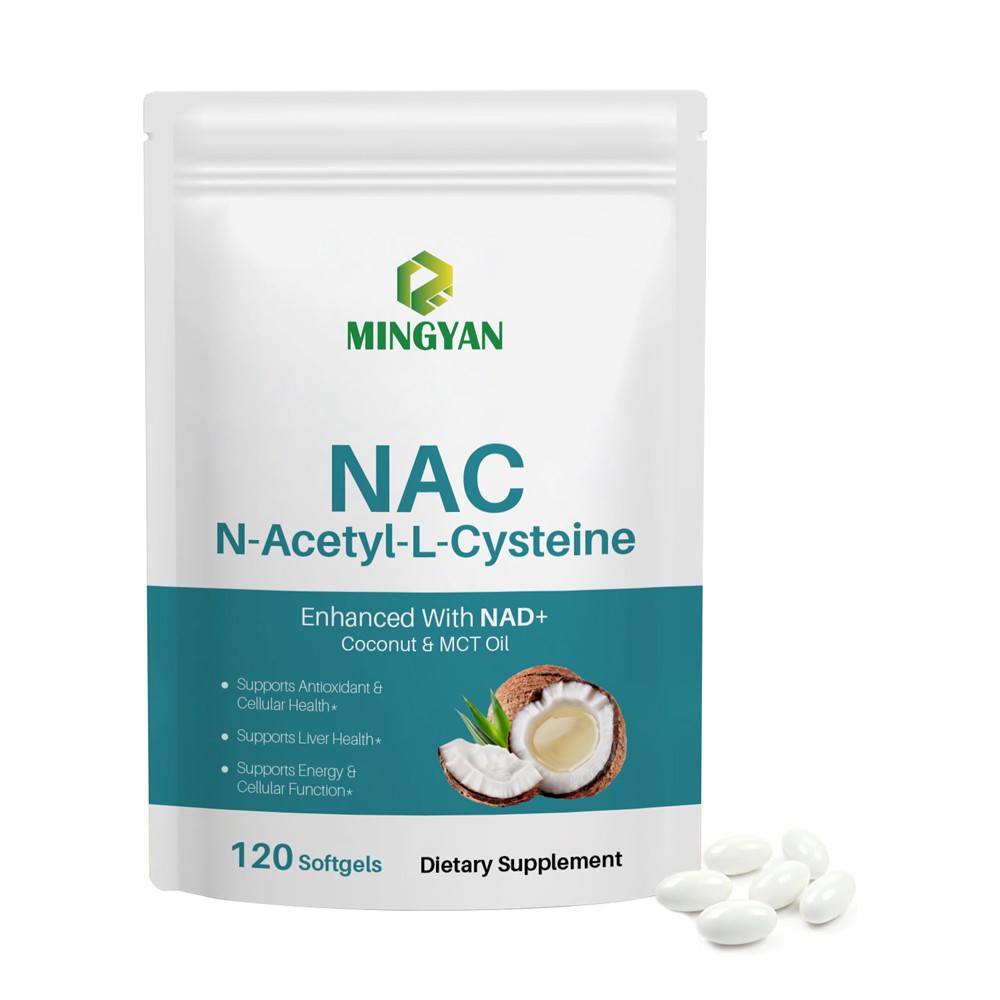
We also offer an NAC softgel product concept containing NAC, NAD+, coconut oil, and MCT oil. The current product configuration includes a 600 mg NAC formula option and a 120-softgel pouch format, while final formula strength, count, shell, packaging, and label details can be reviewed for private label projects.
Technical note: the final physical state of each active, particle characteristics, viscosity, suspension or dispersion behavior, shell-fill compatibility, manufacturing parameters, and finished-product stability depend on the approved commercial formulation and require formula-specific evaluation.
This softgel format should therefore be considered an alternative dosage-form pathway, not an automatic replacement for a conventional NAC 600 mg capsule.
NAC has a specific regulatory history in the United States that deserves separate review when developing products for the U.S. market.
FDA has concluded that NAC is excluded from the statutory definition of a dietary supplement because NAC was approved as a new drug before FDA was aware of evidence that it had been marketed as a food or dietary supplement. FDA's current guidance nevertheless states that the agency intends to exercise enforcement discretion for certain NAC-containing products labeled as dietary supplements when those products would otherwise be lawfully marketed dietary supplements and are not otherwise in violation of the FD&C Act.
Ingredient status: NAC has a specific statutory dietary-supplement-definition issue under FDA's interpretation.
Enforcement policy: FDA currently maintains an enforcement-discretion policy for certain otherwise lawfully marketed NAC products labeled as dietary supplements.
Separate compliance review: formulation, manufacturing, labeling, claims, CGMP, and other applicable FD&C Act requirements still need to be evaluated independently.
Enforcement discretion is not FDA approval, FDA certification, or a blanket determination that every NAC supplement is compliant. Brands preparing a U.S.-market NAC product should review the current FDA NAC guidance and assess product-specific regulatory requirements before launch.
Formula approval and marketing-claim approval are separate workstreams. A technically feasible NAC capsule can still create regulatory risk if the label, website, advertising, or other product communications make inappropriate claims.
FDA distinguishes dietary supplement structure/function claims from disease claims. Structure/function claims can describe an ingredient's role in affecting normal structure or function, but the responsible company must have substantiation showing that the statement is truthful and not misleading. Applicable notification and disclaimer requirements must also be addressed.
Disease claims that state or imply that a dietary supplement diagnoses, mitigates, treats, cures, or prevents a disease can cause the product to fall within drug-regulation requirements unless another lawful pathway applies.
For sourcing and product development, the practical lesson is to avoid finalizing formulation, artwork, and packaging while leaving claims review until the end. Formula specifications, intended label claims, substantiation, destination-market requirements, and artwork should be coordinated before commercial production is locked.
A private label NAC supplement can range from a relatively standardized product with custom branding to a substantially customized formulation. The more variables a project changes, the more formulation review, sampling, specification work, packaging development, and quality review may be required before commercial production.
For a hard-capsule NAC project, customization may involve NAC strength, additional dietary ingredients, serving configuration, capsule shell and appearance, capsule count, bottle or pouch configuration, label artwork, secondary packaging, target-market presentation, and project-specific documentation requirements. Each requested option remains subject to formulation feasibility and applicable product requirements.
Through our custom supplement OEM and ODM services, we can support formula selection, custom formulation, sampling, dosage-form development, manufacturing, packaging, quality inspection, and delivery coordination across multiple supplement formats.
For NAC projects, the initial technical brief is most useful when it defines the desired commercial specification rather than only providing the ingredient name and target strength.
MOQ is partly a commercial question and partly a manufacturing-system question. Formula complexity, raw-material procurement quantities, capsule and packaging requirements, printed-component minimums, production scheduling, and testing requirements can all affect the commercial minimum for a project.
For this reason, MOQ should be confirmed against the actual formula and packaging configuration rather than assumed from another NAC project. The same principle applies to lead time.
A meaningful production schedule separates formula review, raw-material sourcing, sample preparation, sample approval, packaging development, artwork approval, packaging-component procurement, manufacturing, testing or verification, quality release, and shipment.
Scale-up also requires technical review. A formulation that can be prepared successfully as a small development sample still needs to demonstrate appropriate manufacturability at commercial scale. Powder flow, blending, fill consistency, raw-material supply, packaging operation, and specification control all need to transition into a repeatable production process.
A useful NAC RFQ should allow formulation, quality, regulatory, packaging, and commercial teams to review the same product concept rather than answering disconnected questions after a price has already been issued.
What NAC raw-material specification is proposed?
Is the material intended to meet a compendial, supplier-specific, or project-specific specification?
What assay basis is used for the NAC raw material?
How is the requested 600 mg declaration translated into the target amount per capsule and per serving?
What additional active ingredients and excipients are included?
Has the complete formula been assessed for bulk density, flowability, particle behavior, and fill-volume feasibility?
How will capsule size be selected?
If one capsule is not appropriate, can the serving configuration be revised?
Can the proposed raw-material specification and lot-specific raw-material COA be provided?
How is dietary ingredient identity verified for applicable U.S.-market production?
Which component specifications are verified directly and which may rely on qualified-supplier documentation?
What finished-product specification will be approved?
What finished-product testing or verification supports release?
Can a lot-specific finished-product COA or equivalent controlled release document be provided?
How are supplier qualification, batch review, deviations, specification changes, release, and traceability handled?
What destination market is the product being developed for?
How will serving size and dietary ingredient quantity be presented on the intended label?
Who is responsible for final label and claims review?
For the U.S. market, has the current FDA NAC enforcement-discretion policy been considered?
Are proposed structure/function claims supported and reviewed separately from formulation approval?
What bottle, pouch, closure, liner, secondary package, and capsule count are proposed?
Does the packaging specification match the intended storage and product-protection requirements?
What shelf-life statement is proposed?
What data or technical rationale supports the final formula in the intended commercial packaging?
Would a packaging change require stability or specification reassessment?
What is the MOQ for the specific formula and dosage form?
Are there separate minimum quantities for capsules, bottles, labels, pouches, or cartons?
Can development samples or pilot-stage evaluations be produced?
What information must be finalized before a formal quotation?
Which technical or packaging variables can materially change pricing after the initial quote?
How will repeat-order specifications be matched to the approved commercial product?
Price comparisons are only meaningful when the quotations describe substantially the same product. A lower quotation may reflect a different raw-material specification, serving configuration, capsule count, testing scope, packaging system, label responsibility, documentation package, or level of customization.
Procurement teams should normalize quotations around the same commercial specification before comparing unit price. At minimum, compare NAC strength basis, capsules per serving, capsules per package, complete formula, dosage form, packaging, raw-material specification, finished-product verification scope, label requirements, destination market, MOQ, development requirements, and commercial terms.
This is especially important for a broad specification such as “600 mg NAC supplement.” Two products can both display 600 mg prominently while representing materially different manufacturing requirements.
A capable NAC supplement manufacturer should be able to move the discussion from an ingredient concept toward an approved commercial specification without pretending that every technical variable can be answered before formulation review.
For a hard-capsule project, supplier discussions should cover ingredient specifications, complete formula volume, powder behavior, capsule-fill feasibility, serving configuration, component and finished-product specifications, packaging, quality documentation, regulatory requirements, sampling, scale-up, and repeat-order control as connected decisions.
Some questions should remain open until the actual formula is reviewed. Statements such as “this depends on final blend density,” “the approved specification needs to define that,” or “this requires formula-specific stability evaluation” are technically more meaningful than unsupported universal answers.
At Mingyan, we support capsule, softgel, gummy, tablet, powder, and other supplement projects together with formula development, sampling, manufacturing, packaging, and OEM/ODM coordination. For an NAC project, you can share the target strength, intended dosage form, serving configuration, additional ingredients, package format, destination market, and required documentation so the project can be reviewed as a complete commercial specification.
No universal capsule size can be selected from the 600 mg NAC declaration alone. Capsule-size feasibility depends on the total powder blend, raw-material and excipient volume, bulk and packing density, flowability, particle behavior, additional active ingredients, manufacturing requirements, and intended number of capsules per serving.
No. The 600 mg figure may describe the intended NAC quantity associated with the labeled serving or dosage unit. Total powder fill can also include additional active ingredients and excipients. The gross finished-capsule weight additionally includes the capsule shell.
Serving configuration determines whether the declared 600 mg NAC amount is delivered by one capsule or multiple capsules. For U.S. dietary supplements, serving size and dietary ingredient quantity are linked through the Supplement Facts declaration and label directions.
For supplier qualification, brands should generally review evidence relating to both incoming material and finished-product conformity. A finished-product COA or equivalent controlled release document can communicate lot-specific results against the approved finished-product specification. The exact document package should be defined for the project and destination market.
Not by itself. For manufacturers subject to U.S. dietary supplement CGMP requirements, 21 CFR 111.75 requires at least one appropriate test or examination to verify the identity of each dietary ingredient before use unless the specified FDA exemption applies. The regulation separately establishes conditions for relying on supplier COAs for applicable component specifications.
Raw-material stability should not be used by itself to assign finished-product shelf life. The final formulation, dosage form, capsule shell, excipients, environmental exposure, storage conditions, and commercial container-closure system can all affect stability. Brands should request appropriate supporting data or technical justification for the final commercial configuration.
Compare quotations using the same NAC specification, active-strength basis, serving configuration, complete formula, capsule requirements, package count, packaging system, testing and documentation scope, destination market, MOQ, and customization requirements. Otherwise, two quotations for “NAC 600 mg capsules” may represent materially different products.
The development team should determine whether each active is dissolved, dispersed, suspended, or otherwise incorporated in the fill; assess active loading, viscosity, distribution uniformity, particle or sedimentation behavior where relevant, carrier compatibility, shell-fill compatibility, unit-to-unit consistency, finished-product stability, and packaging suitability. An oil-containing formula does not automatically mean every active ingredient is oil-soluble.
No. FDA's enforcement-discretion policy is not FDA approval, certification, or a blanket determination that every NAC supplement, formulation, label, or marketing claim complies with applicable law.
A useful NAC manufacturing inquiry should include the target NAC strength, amount per dosage unit, intended serving configuration, preferred dosage form, additional ingredients, capsule or shell requirements if already defined, package count, packaging format, destination market, expected order quantity, and required quality or regulatory documents.
These details allow us to review formulation feasibility, sourcing requirements, dosage-form selection, packaging, and commercial requirements as one project rather than quoting from the phrase “NAC 600 mg” alone.
To prepare a project-specific quotation, contact our team with your NAC formulation and RFQ requirements →


