Views: 0 Author: Site Editor Publish Time: 2026-09-04 Origin: Site
There is no well-established universal “best” clock time to take an NAC supplement. The practical decision is usually based on three things: the finished product’s label directions, how you tolerate it, and whether a clinician or pharmacist has given you product-specific advice.
N-acetyl-L-cysteine (NAC) is an acetylated form of L-cysteine and is commonly discussed as a cysteine source involved in glutathione synthesis. When people search for the best time to take NAC, however, they are usually asking a practical supplement-use question rather than a biochemical one.
The important point is that timing advice should not be borrowed from prescription acetylcysteine protocols or from an unrelated clinical study. Drug products may use condition-specific routes, doses, and schedules. A dietary supplement should be used according to the directions on the specific finished product, with individual medical factors handled by a qualified healthcare professional.
Morning and evening are both possible routines when the label does not specify otherwise.
There is not a universal evidence-based rule that every oral NAC supplement should be taken one way.
The serving pattern should come from the finished label or individualized professional guidance.
For general supplement use, there is no well-established rule that NAC must be taken in the morning or at night. Research studies use different schedules because they are designed around different research questions; that does not create a universal consumer timing recommendation.
That means morning can be convenient for someone who prefers a morning routine, while evening can be convenient for someone who already takes supplements later in the day. Convenience is not the same thing as evidence that one clock time produces a better biological effect.
This is one of the most searched NAC timing questions, but it is also where online advice often becomes more confident than the evidence supports. Pharmacokinetic literature on NAC does not establish a simple universal rule that an oral NAC supplement is always better absorbed on an empty stomach or should always be taken with food.
| Situation | Practical interpretation | What not to assume |
|---|---|---|
| The label specifies meal timing | Follow the finished product’s directions unless a healthcare professional advises otherwise. | Do not override the label with a generic online rule. |
| The label is silent on food | Avoid inventing an absorption rule. If you notice digestive discomfort, ask whether changing the meal context is appropriate for that product. | Do not assume “empty stomach = better absorption” or “fat-containing meal = better NAC performance.” |
A softgel that contains MCT oil or coconut oil does not automatically need to be taken with a fatty meal. The presence of an oil carrier is a formulation fact, not a consumer timing instruction.
Clinical and pharmacokinetic studies have used many different NAC amounts and administration schedules. Those protocols are useful for answering the study’s research question, but they should not be converted into a general supplement regimen.
For a retail supplement, the serving size and suggested use on the finished label are the relevant starting points. If a product is labeled for one serving, do not create an AM/PM split simply because another study used divided administration. If a product is labeled for more than one serving, follow that product’s directions rather than assuming a specific spacing interval.
Published pharmacokinetic estimates vary with formulation, dose, what form of NAC is measured, and study design. A half-life value from one study is not enough to prescribe a once-daily or divided supplement schedule.
Check serving size, suggested use, meal context if stated, and any cautions.
If the routine causes stomach discomfort or another unexpected effect, do not keep adjusting the regimen by trial and error; ask for qualified guidance.
Prescription medicines, pregnancy or breastfeeding, medical conditions, and upcoming procedures are reasons to discuss supplement use with a clinician or pharmacist.
When the label does not require a specific clock time, a consistent and practical routine is more useful than chasing an unsupported “optimal” hour.
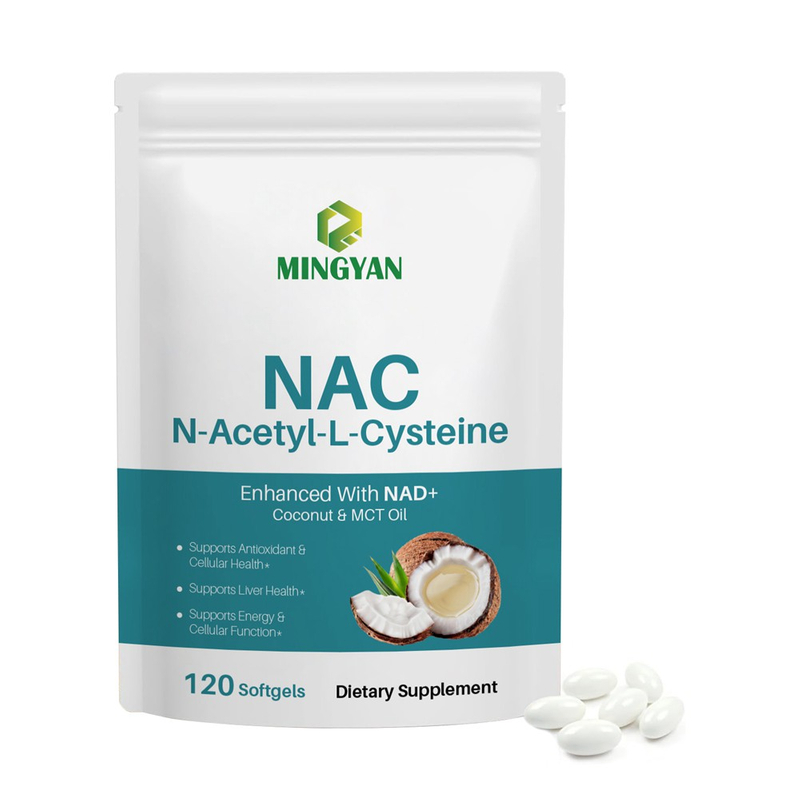
Dosage form and carrier system matter when a product is developed, but they should not be turned into timing instructions without an approved finished-product label. Our current NAC softgel provides a useful example of that distinction.
The presence of MCT or coconut oil does not create a general rule that this softgel should be taken with a meal. Formula-specific directions should be established for the finished commercial product rather than inferred from the carrier alone. Brands evaluating the dosage-form side of the decision can also review our softgel manufacturing capabilities.
Timing questions become medical questions when medicines, pregnancy or breastfeeding, an ongoing health condition, or a planned procedure may affect whether an NAC supplement is appropriate. In those situations, a clinician or pharmacist should evaluate the specific product and your individual circumstances.
Clinical research has reported that NAC can potentiate the blood-pressure effects of nitroglycerin in medical settings. That does not establish a universal interaction rule for every supplement product or dose, but it is a good example of why people using prescription medicines should ask a clinician or pharmacist before adding NAC.
Do not use prescription acetylcysteine schedules, poisoning-treatment protocols, or other medical regimens as instructions for an over-the-counter supplement. FDA’s current NAC guidance also reflects the ingredient’s unusual U.S. regulatory history; enforcement discretion should not be interpreted as FDA approval of NAC supplements.
For a private-label or OEM project, define the dosage form, serving basis, formula, and intended label directions before commercial production. A “600 mg NAC” concept alone does not tell consumers when to take the product or whether 600 mg applies to each softgel.
For deeper sourcing questions, see our NAC 600 mg sourcing guide.
There is no well-established universal advantage to morning or evening use for a general NAC supplement. If the label does not specify a clock time, use the schedule that fits your routine and any individualized professional guidance.
A simple “empty stomach is better” rule is not established for every oral NAC supplement. Follow the product directions. If the label is silent and the product causes discomfort, ask whether changing the meal context is appropriate rather than assuming that one condition is pharmacologically superior.
Not simply because it contains MCT oil. Carrier oil is part of the formulation; it does not automatically create a meal-timing requirement. The finished label should state the intended directions.
Only when the finished product directions or qualified professional advice support that pattern. Do not convert a research protocol or a pharmacokinetic half-life value into your own split schedule.
Ask a clinician or pharmacist before combining NAC with prescription medicines. Interaction relevance depends on the medicine, dose, formulation, and individual medical circumstances.
A universal duration recommendation is not appropriate for every person or product. Use the serving and frequency stated on the specific finished label, and seek professional advice when long-term use or a health condition is part of the decision.
The best time to take NAC is not a universal hour on the clock. For a dietary supplement, start with the finished product’s directions, then consider tolerability, your daily routine, medicines, and individual health factors.
Morning and evening can both be workable routines when the label does not say otherwise. The available evidence does not justify a blanket rule that every NAC supplement should be taken on an empty stomach, with a meal, or in divided servings. Likewise, an oil-containing softgel does not create its own meal-timing rule.
For consumers, the safest practical principle is simple: follow the specific product label and ask for professional guidance when medical factors apply. For supplement brands, timing language should be built from the approved formula, serving configuration, and finished label—not copied from a generic NAC schedule.