Views: 0 Author: Site Editor Publish Time: 2026-09-07 Origin: Site
Aged garlic extract and garlic extract should not be compared as if one were simply a stronger version of the other. The useful difference is preparation identity: processing changes the constituent profile, the marker strategy, the physical form and the specification language a brand needs to approve.
For sourcing, start with four questions: What preparation is this? What marker is being controlled? What does the extract ratio or equivalent actually mean? What amount of extract will the finished label declare?
Searches for aged garlic extract vs garlic extract often drift into benefit comparisons. That is not the best starting point for a supplement brand, product developer or procurement team. Before discussing positioning, the project has to identify the preparation itself.
Garlic supplements can be made through substantially different processing routes. Published reviews describe major preparation categories including dehydrated garlic powder, garlic oil, garlic oil macerate and aged garlic extract. Those categories should not be collapsed into a single interchangeable “garlic extract” specification, because processing changes which constituents remain, which markers are meaningful and how the finished ingredient can be formulated.
The term by itself does not define the extraction solvent, processing temperature, concentration ratio, physical form or marker compound. A usable specification has to add those details.
Published AGE research describes prolonged processing that changes the constituent profile over time. Commercial suppliers should still define their own aging process, raw-material basis, marker specification and physical form.
Aging changes the chemistry rather than simply concentrating the same marker profile. A non-aged garlic preparation with a high allicin-potential specification and an aged preparation standardized to an aging-associated marker are not two strength grades of one ingredient.
The practical sourcing question is therefore not “which name sounds more premium?” It is “which preparation matches the product concept, and which specification proves that the material received is the preparation that was approved?”
A widely cited garlic-supplement review grouped commercial preparations into four categories. The grouping is useful because it demonstrates how the same plant can become chemically different ingredients after processing. It should not be read as a claim that all four are literally “extracts” under one labeling definition.
A powder preparation rather than a concentrated extract. Specifications may focus on the powder itself, alliin content, allicin potential or other defined attributes depending on the product.
Produced through a route such as distillation and characterized by oil-soluble volatile sulfur compounds. Its marker profile is different from a dried powder or aged aqueous/hydroalcoholic preparation.
An oil-based preparation whose composition depends on the starting garlic, carrier, contact conditions and process. It should not be assumed equivalent to steam-distilled garlic oil.
Published AGE preparations undergo prolonged processing in which sulfur-containing compounds change over time. SAC and other aging-associated constituents are commonly discussed in the scientific literature.
This is why a procurement request that says only “garlic extract” is incomplete. The supplier needs to know whether the project is requesting a powder preparation, an oil-based material, an oil macerate, an aged extract or another clearly defined botanical extract system.
Garlic chemistry changes after the bulb is cut, crushed, extracted and held over time. The most useful way to understand aged garlic extract is therefore as a changing constituent profile rather than a fixed list of compounds that simply becomes more concentrated.
Allicin is produced after garlic tissue is disrupted and alliinase can act on its precursor. It is chemically unstable. Published reviews of garlic preparations describe allicin and related thiosulfinates as disappearing during processing and transforming into other organosulfur compounds. In published aged-garlic chemistry work, allicin disappears early in the aging process.
That makes allicin potential and an aged-garlic marker specification different analytical concepts. An allicin-potential figure can be useful for products designed around precursor/enzyme chemistry, but it should not be silently translated into an SAC specification.
S-allyl cysteine (SAC) is strongly associated with aged garlic extract in the literature, but it is more accurate to say that SAC is present only at very low levels in raw garlic and increases during processing and aging. Published chemistry reviews describe SAC and related sulfur-containing amino acids as products whose levels change through chemical and enzymatic reactions during the aging process.
S-allylmercaptocysteine (SAMC) is another characteristic hydrophilic constituent discussed in aged-garlic research. The relevant sourcing lesson is not to memorize one pathway; it is to require the commercial ingredient specification to state which marker or marker set is controlled and which analytical method supports it.
Aging and processing can substantially change garlic's volatile sulfur profile, and some aged garlic products are positioned as low-odor or odorless. If a commercial product makes that claim, the finished-product specification should define how the sensory characteristic is controlled or supported. SAC content by itself should not be treated as a direct analytical measurement of odor.
A precursor present in garlic. Its relevance depends on the preparation and on whether the product relies on the alliin/alliinase system.
A functional or analytical expression related to how much allicin can be generated under defined conditions. It is method- and formulation-dependent.
A stable, water-soluble constituent commonly used in research and commercial specifications to characterize aged garlic preparations.
An SAC specification and an allicin-potential specification describe different chemical systems. A supplier cannot make one quote comparable to the other by applying a simple numerical conversion. If the marker changes, treat it as a different ingredient specification and review the product concept again.
The analytical method matters too. A marker percentage without a method, basis and units can still be ambiguous. The RFQ should therefore request the marker, target or range, analytical method and whether the result is stated per gram of extract, per serving or on another defined basis.
Botanical sourcing becomes confusing when three valid but different quantities are presented side by side without a basis. A 15:1 ratio, a 500 mg garlic equivalent and the actual mass of dried extract in a dosage unit do not mean the same thing.
A ratio such as 15:1 describes a relationship between the starting botanical material and the resulting extract under a defined manufacturing basis. The starting-material condition and calculation basis matter.
An equivalent expresses the amount of original garlic represented by the extract under the stated ratio or calculation. It is not automatically the physical extract mass inside the dosage unit.
For a dried botanical extract, this is the mass of dried extract used in the serving or dosage unit. It is a separate quantity from the herb-equivalent statement.
For U.S. dietary-supplement labeling, FDA distinguishes liquid and dried botanical extracts. For a dried extract from which the solvent has been removed, the quantitative amount is the weight of the dried extract. For a liquid extract, the total extract may be listed by volume or weight, with the starting-material condition and other permitted concentration information presented appropriately.
An extract ratio or original-herb equivalent can provide useful additional context, but it should not be used to hide or replace the required quantitative amount of a dried extract on a U.S. Supplement Facts panel. The label, raw-material specification and artwork should all use the same defined basis.
This also means a buyer should not reverse-calculate a precise extract weight from a published ratio unless the approved specification defines the starting-material basis, ratio calculation and finished extract quantity. Two suppliers can both use “15:1” while applying different raw-material conditions or processing assumptions.
FDA Dietary Supplement Labeling Guide: Botanical Extracts →
| Decision point | General garlic extract / preparation | Aged garlic extract |
|---|---|---|
| What the name tells you | Not enough by itself; extraction route, physical form and marker still need definition. | The material is intended to represent an aged preparation, but the commercial aging process still needs supplier definition. |
| Marker strategy | May involve alliin, allicin potential, volatile sulfides or another defined marker depending on preparation. | SAC is commonly used to characterize aged preparations; the supplier should state the marker and method. |
| Processing information | Extraction / concentration method and raw-material basis should be stated. | Aging / maturation description is an important part of establishing preparation identity. |
| Ratio / equivalent | Possible, but only meaningful when the ratio basis and actual extract amount are defined. | The same rule applies; “aged” does not make a 15:1 ratio self-explanatory. |
| Dosage-form decision | Depends on whether the commercial ingredient is a dry powder, oil, liquid extract or another defined form. | Also depends on the physical form supplied; aged extract does not automatically mean softgel or hard capsule. |
| Most important RFQ question | “Which preparation, marker, method and extract basis are you quoting?” | “How is the aged preparation defined, and what marker / method supports that specification?” |
The table is deliberately a specification comparison, not a quality ranking. A non-aged garlic preparation can be entirely appropriate when its chemistry and dosage-form requirements match the product brief. An aged extract can be appropriate when the project specifically requires an aged constituent profile and the supplier can document that preparation.
The preparation name does not dictate the dosage form. The physical form of the commercial ingredient and the finished formula do.
A dried garlic extract can be evaluated in a conventional powder-filled capsule using its actual extract weight, bulk properties, excipient system, capsule volume and serving target.
Oil-based, liquid or suitably dispersed botanical ingredients may be evaluated for softgel development. Feasibility depends on the actual ingredient, carrier system, active loading, viscosity, distribution and shell-fill compatibility.
Do not assume that every aged garlic extract is oil-soluble, that every aged preparation belongs in a softgel, or that a garlic oil preparation belongs in a conventional dry-fill capsule. The dosage form should follow the physical and chemical properties of the approved commercial ingredient.
MINGYAN supports both capsule manufacturing and softgel manufacturing, allowing the project to begin with the ingredient specification rather than forcing the ingredient into one preset format.
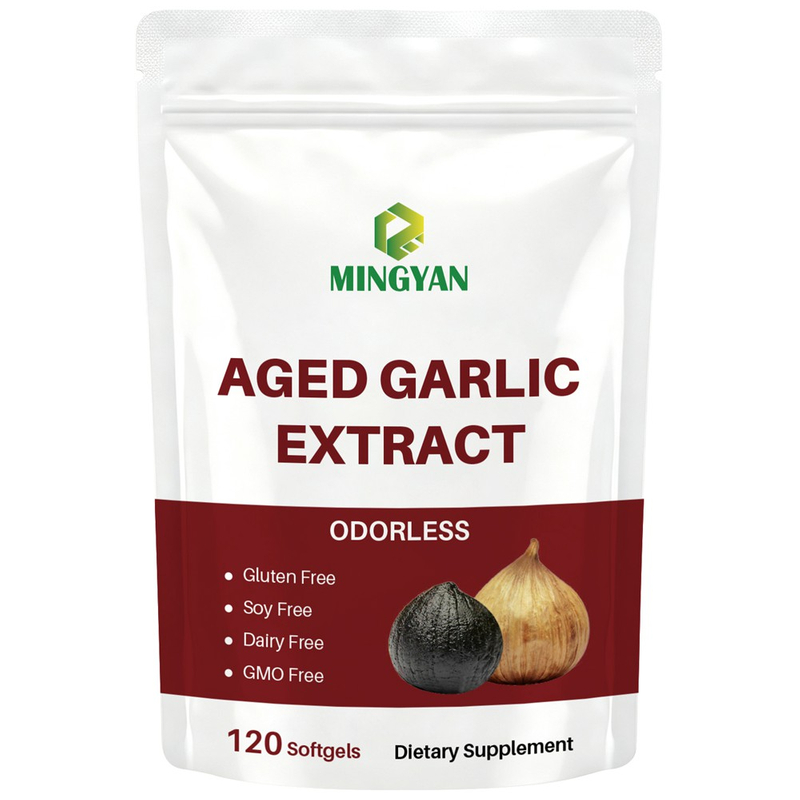
The published 500 mg figure is an aged garlic equivalent per softgel, not a statement that each softgel contains 500 mg of dried extract. The 15:1 ratio describes the relationship between the original garlic material and concentrated extract. The exact extract mass and calculation basis should follow the approved raw-material and finished-product specification; they should not be reverse-engineered from the marketing figures alone.
Our current product page also notes that the final extract ratio, raw-material specification and per-softgel quantity are confirmed during product development. That distinction matters for private-label work: the displayed product is a starting configuration, while the commercial specification has to define the actual ingredient amount, serving information, shell, packaging and label for the project being made.
The odorless positioning is likewise a finished-product characteristic. For a customized formula, sensory expectations should be confirmed with the selected raw material and finished product rather than assumed from the words “aged garlic extract” alone.
Price comparisons are only useful when suppliers are quoting the same preparation. Use the block below to turn “aged garlic extract, please quote” into a brief that can be compared line by line.
Destination market: ______________________________
Preparation category: ______________________________
Botanical identity / plant part: ______________________________
Aging / extraction description: ______________________________
Physical form: □ dry extract □ liquid □ oil-based □ other __________
Marker + target / range + method: ______________________________
Extract ratio + basis: ______________________________
Actual extract amount per serving / unit: ______________________________
Herb-equivalent statement, if used: ______________________________
Preferred dosage form: □ capsule □ softgel □ request recommendation
Units per serving / package count: ______________________________
Packaging: ______________________________
Required testing / documents / claims: ______________________________
If the product concept is still open, mark the undecided fields as development items instead of filling them with assumptions. Through our OEM / ODM supplement development process, we can evaluate the dosage-form and specification path around the commercial ingredient that the project actually intends to use.
No. Aging changes the constituent profile. A non-aged preparation and an aged preparation may use different marker systems, so the comparison is about preparation identity and specification rather than a single universal strength scale.
Do not assume aged garlic extract is an allicin-standardized ingredient. Published aging research describes allicin as disappearing early during aging while other sulfur-containing constituents change or increase. The commercial specification should state the marker system actually being controlled.
SAC is a stable, water-soluble sulfur-containing constituent that increases during garlic processing and aging and is widely associated with AGE characterization in published research. For sourcing, the important point is to pair any SAC target with an analytical method, units and an approved ingredient specification.
No. A 15:1 ratio describes a relationship between starting botanical material and extract under a defined basis. It does not tell you the marker concentration, actual extract weight per dosage unit or clinical potency by itself.
No. An original-herb equivalent and the physical mass of extract are different quantities. Our current product displays the equivalent of 500 mg aged garlic per softgel; the approved raw-material and finished-product specifications determine the extract amount and ratio basis for the commercial project.
The answer depends on the physical form and formulation of the commercial aged garlic ingredient. Dry extracts can be evaluated for conventional powder-filled capsules, while suitable liquid, oil-based or dispersed systems may be evaluated for softgels. The dosage form should follow the actual ingredient rather than the marketing name.
Ask for the preparation identity, species and plant part, aging / extraction description, physical form, extract ratio and its basis, actual extract amount, marker specification and method, applicable contaminant controls, packaging / storage requirements and support for any sensory or market claims.
For an aged garlic extract project, tell us the destination market, commercial ingredient specification, desired marker or extract ratio, serving target, preferred dosage form and packaging requirements. We can identify which fields are already defined and which still need formulation or dosage-form development before quotation.
Send an Aged Garlic Project Brief →