Views: 0 Author: Site Editor Publish Time: 2026-09-08 Origin: Site
There is no universal winner in the Ceylon cinnamon vs cassia cinnamon comparison. For supplements, the better choice is the species that matches the approved product specification, coumarin-control strategy, dosage form, positioning and target market.
The most useful distinction is this: species is a screening signal; specification is the control. Ceylon is associated with a lower-coumarin species profile, while cassia can contain substantially more coumarin, but neither species name replaces lot identity, an approved specification or project-specific testing.
A supplement labeled simply as “cinnamon” leaves an important sourcing question unanswered. Commercial cinnamon materials can come from different Cinnamomum species, and the species can differ in chemical profile, supply chain, cost and the way a brand approaches coumarin control.
For product development, the comparison should therefore begin before benefit claims or marketing language. Define the botanical species and plant part, confirm the commercial extract, separate the extract ratio from the herbal equivalent and actual extract quantity, and then decide which dosage-form and quality controls fit the project.
Also widely referenced as Cinnamomum zeylanicum and commonly marketed as “true cinnamon.” Ceylon cinnamon is strongly associated with Sri Lankan supply and is frequently selected when the project specifically requires C. verum identity.
Cassia is also widely referenced in commercial and scientific literature as Cinnamomum cassia. Because botanical nomenclature and trade usage can differ, the approved specification should state the botanical identity and relevant synonym used by the supplier rather than relying on the common name alone.
A useful specification identifies the botanical species, plant part and commercial preparation and states how identity will be established for the actual material. The common word “cinnamon” does not do that work.
Cinnamon products can also use different plant parts. This guide focuses primarily on cinnamon bark extract because that is the material relevant to MINGYAN's current Ceylon cinnamon softgel and to many supplement projects. If a project uses leaf, root or another part, treat it as a different botanical specification rather than transferring a bark specification automatically.
| Decision point | Ceylon cinnamon | Cassia cinnamon | What the buyer should decide |
|---|---|---|---|
| Species identity | Cinnamomum verum | Cinnamomum aromaticum, commonly referenced as cassia and also as Cinnamomum cassia | Which botanical identity belongs in the approved raw-material and finished-product documents? |
| Coumarin profile | Generally associated with much lower coumarin levels; trace amounts can still occur. | Can contain substantially more coumarin, with meaningful lot and product variation. | Does the project need a coumarin specification or testing plan based on market, formula and risk assessment? |
| Commercial positioning | Frequently selected for “Ceylon” or “true cinnamon” positioning and for products where lower-coumarin species identity is commercially important. | A common commercial cinnamon with broad availability and different cost dynamics. | Is the species itself part of the brand proposition, or is cinnamon being used as a generic botanical? |
| Supply-chain risk | A project marketed specifically as Ceylon needs controls that prevent substitution with another cinnamon species. | The project still needs a defined species, plant part and specification rather than “generic cinnamon.” | Can the supplier connect the botanical identity on the specification to the material actually purchased? |
| Extract semantics | Ratio, herbal equivalent and actual extract amount remain separate quantities. | The same rule applies. | Are all suppliers quoting the same species and the same extract basis? |
| Dosage form | Can be developed in softgel or other formats when the actual commercial extract and formulation are compatible. | Also dependent on the actual extract and formulation rather than species name alone. | What physical ingredient is being supplied, and which format can manufacture it reliably? |
The useful conclusion is not that one species wins every row. Ceylon is often the cleaner fit when a brand intentionally wants C. verum identity and a lower-coumarin species profile. Cassia remains a legitimate botanical ingredient when it is deliberately selected, correctly identified and controlled within the product specification.
Coumarin is the main reason the Ceylon-versus-cassia distinction matters beyond naming. Cassia cinnamon can contain considerably more coumarin than Ceylon cinnamon, but the amount is not fixed by the species name alone. Raw material, growing conditions, processing and the specific commercial product can all influence the measured result.
That makes Ceylon commercially attractive when low-coumarin positioning or reduced coumarin uncertainty is part of the product brief.
If coumarin matters to the product, set an appropriate project specification and verification approach rather than copying a typical literature number into the RFQ.
Current safety guidance describes Ceylon cinnamon as potentially containing trace coumarin and cassia as having more variable and sometimes higher levels. Use the species distinction to design the specification—not as a substitute for the specification.
Current European flavouring rules use different maximum coumarin levels for specific compound-food categories, including certain bakery products, breakfast cereals and desserts. Those category-specific food limits should not be converted into a universal “European cinnamon supplement limit.” A supplement project intended for the EU should review the actual product category and current market requirements separately.
The same principle applies in the United States: a brand can choose to include coumarin in its supplier or finished-product specification when the project's risk assessment supports doing so, but the test scope should come from the approved product and quality strategy rather than a generic internet threshold.
Species identity matters partly because cinnamon research often combines or incompletely identifies different species, plant parts and preparations. That makes broad conclusions about “cinnamon” difficult to transfer to one specific commercial extract.
Current U.S. health guidance does not clearly support cinnamon for any health condition and describes the evidence for areas such as diabetes and weight management as uncertain. For a supplement brand, that means choosing Ceylon over cassia can be a legitimate identity, sourcing and positioning decision, but the species switch does not create a health claim by itself.
“Made with Ceylon cinnamon” describes the botanical identity when the specification supports it. A statement implying that Ceylon cinnamon produces a particular health outcome is a different claim and needs its own substantiation and target-market review.
For a botanical project, “identity confirmed” should mean more than seeing the correct common name on a supplier COA. The approved material should be connected to a botanical identity, plant part, commercial preparation and appropriate identity-verification approach.
The identity method deserves particular attention for extracts. Processing can remove or alter some morphological or genetic features that are available in intact bark, so the manufacturer and raw-material supplier should use methods that are appropriate to the actual commercial material rather than promise “DNA testing” or another technique by default.
If the approved product is Cinnamomum verum bark extract, a switch to cassia is a product change—not a routine purchasing substitution. The commercial agreement should define which ingredient changes require review before they are introduced into production.
Cinnamon extract specifications often look stronger than they are because a high ratio and a large herbal-equivalent number can visually dominate the page. Neither one tells you the physical extract quantity in the finished serving unless that quantity is stated separately.
A ratio such as 12:1 describes a relationship between starting botanical material and extract under a defined manufacturing basis.
Expresses how much starting cinnamon material the serving represents under the specified extract basis.
The actual mass of commercial extract used in the unit or serving. This quantity should not be reverse-calculated from a marketing equivalent unless the approved specification establishes the basis.
For a dried botanical extract from which the solvent has been removed, the quantitative amount is the weight of the dried extract. An extract ratio or herbal-equivalent statement can provide additional information, but it should not replace the required extract quantity.
This distinction is especially important when comparing suppliers. Two products can both advertise “12:1 Ceylon cinnamon” while using different actual extract amounts, serving configurations or raw-material specifications.
Species identity and dosage form are separate decisions. Ceylon cinnamon does not automatically belong in a softgel, and cassia does not automatically belong in a powder capsule. The physical form and formulation of the commercial ingredient determine which manufacturing route is practical.
When a cinnamon extract is formulated into a softgel-compatible system, evaluate the actual extract amount, carrier where applicable, physical state, viscosity, active distribution, shell compatibility, fill volume and packaging together.
A suitable dry cinnamon extract can be evaluated with the other powder ingredients for complete blend mass, density, flow, capsule volume, serving configuration and filling consistency.
The question is therefore not “Which dosage form is best for Ceylon cinnamon?” It is “What is the approved commercial extract, what physical form does it have, and which dosage-form system can repeatedly manufacture the intended serving?”
MINGYAN supports both softgel manufacturing and hard-capsule manufacturing, so the project can begin with the botanical specification instead of forcing every cinnamon extract into one preset format.
For this current product direction, MCT oil is the carrier and the extract concentration, carrier volume, fill viscosity, shell compatibility and softgel size are evaluated together during development. Those details belong to this specific formulation pathway and should not be generalized to every Ceylon or cassia extract.
Custom projects can evaluate formula concentration, shell material, softgel size and color, serving specification, package count and branded packaging according to the selected ingredient and target market.
A statement such as “made with Ceylon cinnamon” can describe botanical identity when the product specification and supply chain support that statement. It should not be automatically extended into “therefore better for blood sugar,” “safer for the liver” or another health outcome.
For qualifying U.S. structure/function and related claims under section 403(r)(6), the manufacturer, packer or distributor responsible for marketing the claim must have substantiation that the statement is truthful and not misleading, use the required disclaimer and notify FDA no later than 30 days after first marketing the dietary supplement with the claim.
If a finished product is positioned specifically as Ceylon or “true cinnamon,” the raw-material identity and change-control system should support that positioning. Treat it as a botanical identity statement that needs supply-chain evidence, not as decorative marketing copy.
The answer depends on which product problem the species is meant to solve. Use the decision framework below instead of ranking the two cinnamons on a universal quality scale.
the brand specifically wants Cinnamomum verum identity;
low-coumarin species positioning is part of the product brief;
“Ceylon” or “true cinnamon” is an intentional differentiator;
the supply chain and budget support a controlled Ceylon specification.
cassia is the deliberately selected botanical identity;
the product does not need Ceylon-specific positioning;
the commercial specification addresses relevant coumarin and quality considerations;
cost and supply availability are important project constraints.
the brief says only “cinnamon extract”;
the plant part is missing;
the ratio basis is undefined;
herbal equivalent is being used as extract weight;
the supplier cannot explain the identity-verification approach.
For most serious supplement projects, the biggest risk is not selecting the “wrong” species. It is approving an incompletely specified species and discovering later that the formula, label and supplier documents were describing different materials.
Destination market: ______________________________
Required species: ______________________________
Botanical synonym used by supplier, if applicable: ______________________________
Plant part: ______________________________
Commercial preparation / physical form: ______________________________
Identity-verification approach: ______________________________
Coumarin requirement, if applicable: ______________________________ / TBD after risk review
Extract ratio + basis: ______________________________
Actual extract amount per serving: ______________________________
Herbal equivalent, if used: ______________________________
Preferred dosage form: □ softgel □ capsule □ request recommendation
Serving Size / units per serving: ______________________________
Package count / packaging: ______________________________
Required quality / batch documents: ______________________________
Species / raw-material change-notification requirements: ______________________________
If the project has not yet decided whether Ceylon or cassia is appropriate, leave the species field open and give the manufacturer the target market, product positioning, serving concept and coumarin expectations. A technical recommendation is more useful when the commercial constraints are visible.
Not universally. Ceylon often fits products that specifically require Cinnamomum verum identity or a lower-coumarin species profile. Cassia can also be a valid supplement ingredient when it is deliberately selected and controlled. The better material is the one that matches the approved product specification and market strategy.
It can contain trace coumarin. Ceylon is generally associated with substantially lower levels than cassia, but “Ceylon” should not be treated as a guarantee of zero coumarin. If a specific coumarin limit matters to the product, include that requirement in the approved specification.
That conclusion is too broad. Cassia is a widely used cinnamon species and its coumarin content varies. The sourcing question is whether the selected commercial material and intended product meet the project's quality and market requirements—not whether the common name can be classified as simply safe or unsafe.
Define Cinnamomum verum, the required plant part and commercial preparation in the raw-material specification. Then confirm that the supplier and manufacturer use an identity-verification approach suitable for that processed botanical material and that the released material is linked to the production lot.
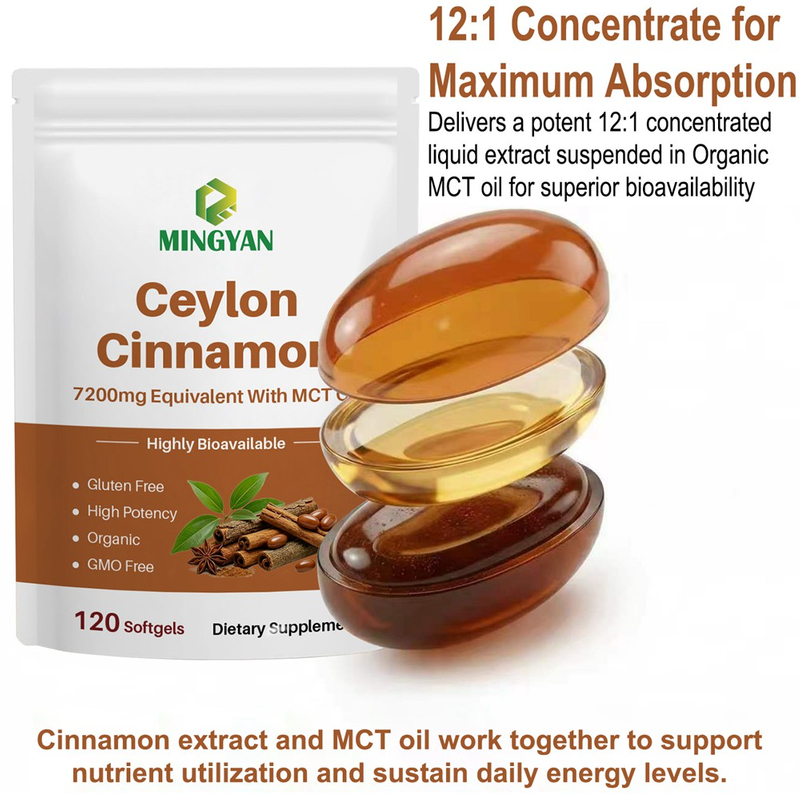
A 12:1 ratio describes a relationship between starting botanical material and extract under a defined manufacturing basis. It does not independently tell you the actual extract quantity per serving, the coumarin level or the amount of any other constituent.
No. A herbal equivalent expresses the amount of original botanical material represented by the extract. Our current Ceylon cinnamon softgel displays a 7,200 mg herbal equivalent per serving, while the actual extract amount and Serving Size belong to the final approved product specification.
Not as a universal rule. Whether coumarin belongs in the raw-material or finished-product test plan depends on the selected species, supplier controls, destination market, product positioning and project risk assessment. When a coumarin limit is important, define both the acceptance criterion and analytical method in the specification.
The species name does not decide the dosage form. A softgel-compatible extract system can be evaluated for softgel production, while a suitable dry extract can be evaluated for a conventional hard capsule. Choose the format from the actual ingredient and complete formula.
For a Ceylon or cassia cinnamon project, tell us the destination market, botanical identity, plant part, extract ratio, intended serving, preferred dosage form, packaging and any coumarin or quality requirements already defined. We can identify which items are ready for quotation and which still require ingredient or formulation review.
Send a Cinnamon Project Brief →