Views: 0 Author: Site Editor Publish Time: 2026-09-06 Origin: Site
“600 mg NAC” is a quantity, but it is not a complete specification. Its meaning depends on the basis attached to the number: per serving, per dosage unit, as a formulation target, as a raw-material weigh-in, or as part of the finished unit.
For a U.S. supplement, the Supplement Facts panel must anchor the dietary-ingredient amount to the labeled serving. For product development, brands and manufacturers then need to connect that declaration to the serving configuration, raw-material assay basis, complete fill, shell and package count without treating those values as interchangeable.
The search question “what does 600 mg NAC mean?” sounds simple because all of the relevant numbers use the same unit: milligrams. The complication is that milligrams can describe different things. A consumer may be looking at the dietary-ingredient amount on a label. A product developer may mean a target per capsule. A formulator may be calculating the mass of an incoming raw material needed to deliver that target. A filling line deals with the complete fill, while packaging handles the gross dosage unit and package count.
The number becomes useful only when the basis is named. That is the job of this page: separate the quantities, show how they connect, and make a “600 mg NAC” brief specific enough that formula development, artwork and quotations are describing the same product.
The dietary-ingredient quantity associated with the labeled serving on the finished product.
The NAC contribution assigned to one capsule, softgel or other unit in the approved formula.
The approved target and raw-material quantity calculated on the defined assay and moisture basis.
The complete dosage-unit and package quantities used for manufacturing and packaging control.
Never read “600 mg” without asking “600 mg of what, per what, and on what basis?” A front-label strength concept alone does not tell you the serving size, capsule size, softgel fill weight, raw-material weigh-in, total fill weight, shell weight or gross finished-unit weight.
A complete NAC specification separates these quantities because each one serves a different technical or labeling purpose.
The important distinction is that only some of these numbers are label declarations. Others are controlled formulation, manufacturing or packaging values. A 600 mg label concept should therefore be translated into these fields rather than copied unchanged from one document to another.
For a U.S.-market dietary supplement, the dietary-ingredient quantity on Supplement Facts is tied to the labeled serving. FDA's dietary-supplement labeling guidance states that the panel lists dietary ingredients and their quantities, Serving Size, and Servings Per Container when required.
FDA guidance describes one serving as the maximum amount recommended on the label for consumption per eating occasion, as appropriate, or one unit when the label gives no recommendation. So Serving Size and Directions must be planned together.
The quantitative amount of the dietary ingredient is presented for the labeled serving. FDA allows wording consistent with that serving, such as “Each Tablet Contains” or “Amount Per 2 Tablets,” when appropriate.
FDA's labeling guide states that information may be presented on a per-unit basis in addition to the required per-serving basis. This is useful when a brand wants consumers or buyers to see both the serving amount and the amount in a single dosage unit. The two should be explicitly labeled rather than inferred.
This is why the original question should not be answered with “600 mg always means one capsule” or even “600 mg always means one serving” without looking at the label context. On the Supplement Facts panel, the required quantity is anchored to the declared serving; additional per-unit presentations are possible when they are presented consistently with the labeling rules.
FDA Dietary Supplement Labeling Guide: Nutrition Labeling →
This is the most commercially important distinction because it changes what each unit must carry.
If the approved formula assigns the full declared amount to that one identical dosage unit, the unit must be formulated to contribute the serving amount.
A common design would allocate 300 mg of NAC contribution to each identical capsule, but that per-unit value belongs to the approved formula—it should not be assumed from the serving count without confirming the product configuration.
“Target: 600 mg NAC per serving; Serving Size: 2 identical capsules; target NAC contribution: 300 mg per capsule.”
That sentence is more useful than “NAC 600 mg capsules” because the manufacturer can now separate the label target from the dosage-unit target. Capsule size, complete fill weight and manufacturing feasibility are still separate questions—and are the subject of our NAC 600 mg capsule sourcing guide.
Once the desired NAC contribution is defined, formulation still has to convert that target into an actual mass of raw material. That conversion depends on the approved raw-material specification and the basis on which the assay is reported.
The current USP-NF Acetylcysteine monograph defines acetylcysteine as containing not less than 98.0% and not more than 102.0% of acetylcysteine, calculated on the dried basis. That compendial range is a reference standard; it does not tell you the assay or moisture result of a specific commercial lot, and it does not prove that a project material is USP-NF conforming unless that conformity is established for the material being used.
A simple potency correction may be possible: target active contribution ÷ assay fraction, subject to the controlled project formula and specification.
Do not simply divide the target by the dried-basis assay and call the result the as-is weigh-in. The calculation also has to reconcile the material's moisture / loss-on-drying basis under the approved specification.
If a hypothetical lot is described as “99.0% on the dried basis,” the formula cannot correctly calculate an as-is weigh-in from 99.0% alone. A moisture-related correction is still missing. This is why a real manufacturing calculation must state the assay basis explicitly rather than treating every percentage as interchangeable.
The other common mistake is assuming that the manufacturing target must automatically exceed the label amount by a fixed overage. FDA's labeling guidance requires specifically added dietary ingredients to support the declared amount, subject to applicable analytical variability, but the exact formulation target, any intentional adjustment and the stability strategy are project-specific controlled decisions. They should not be inferred from the phrase “600 mg.”
USP-NF Acetylcysteine monograph →
The example below is hypothetical. It is not a MINGYAN formula, specification, shell weight, assay result or production target. Its only purpose is to show how the numbers relate mathematically.
The point is not the hypothetical numbers. It is the separation: 600 mg declared per serving ≠ 300 mg target per unit ≠ 303.03 mg raw-material mass ≠ 353.03 mg internal fill ≠ 453.03 mg gross unit weight. Each number answers a different question.
It does not tell you capsule size, powder density, flow, fill variation, actual shell mass, finished-product assay limits, stability, shelf life or whether the formula is commercially manufacturable. Those are separate specification and engineering questions.
The three quantities are often collapsed in RFQs because all are expressed in milligrams. They should instead form a chain.
Defined by the approved product specification and linked to the label declaration.
Raw-material mass plus the rest of the approved internal formulation.
Internal fill plus shell. Useful for manufacturing and packaging control, not as a substitute for the dietary-ingredient declaration.
This distinction applies to both hard capsules and softgels. A “600 mg NAC” strength statement does not mean that the internal fill weighs 600 mg, and a gross finished dosage unit that weighs more than 600 mg does not mean it contains more than 600 mg of declared NAC.
The meaning of the declared active amount does not change when the dosage form changes, but the physical variables around it do.
| Question | Conventional hard capsule | Softgel |
|---|---|---|
| What can “600 mg” validly describe? | A declared amount per serving, or an explicitly defined per-unit amount when the labeling / specification establishes that basis. | The same: the declared NAC amount needs an explicit serving or unit basis. |
| What it does not determine | Capsule size, total powder fill, shell weight, density or fill consistency. | Softgel fill mass, physical state, carrier load, shell mass or unit size. |
| What controls fill feasibility? | Complete blend mass and physical properties, shell volume and filling-process performance. | Physical state, active loading, carrier system, viscosity / particle behavior where relevant, shell-fill compatibility and stability. |
| Most common semantic mistake | Treating 600 mg active as 600 mg total powder fill. | Treating 600 mg active as the total liquid / suspension / semisolid fill mass. |
For the engineering question of whether a 600 mg hard-capsule concept can physically fit and fill reliably, the separate 600 mg NAC capsule formulation page should own that search intent. This article deliberately stops at the semantic boundary: it defines the numbers that the engineering page then uses.
That distinction is especially important on a customizable product page. A formula option is a commercial starting point. The final project still has to define the strength basis, dosage-form configuration, serving information, internal fill, package count and approved artwork.
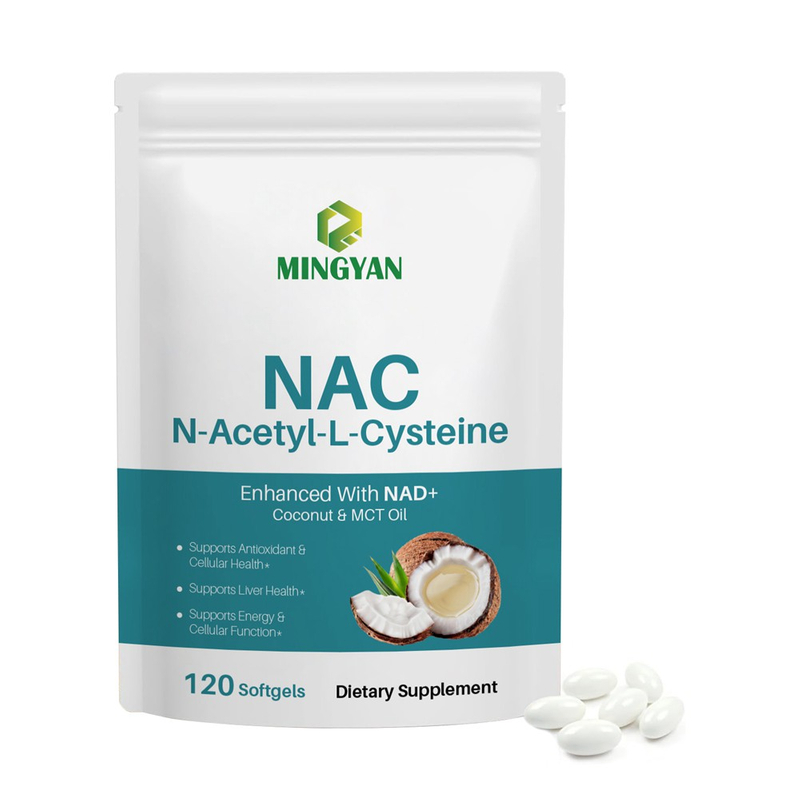
The presence of coconut oil and MCT oil also does not allow the 600 mg number to be reinterpreted as softgel fill mass. A softgel fill can include active ingredients plus carrier and other formulation components; its total mass and physical state are separate technical specifications.
The largest commercial risk is not a calculation error. It is letting different teams use the same phrase to mean different products.
Under 21 CFR Part 111, product specifications and production controls are not created by copying front-label marketing language into a batch record. The controlled product definition has to describe the actual product that will be manufactured and verified. For buyers, the practical consequence is simple: a comparable quote requires the same technical basis across every supplier.
Amount per serving × servings per container = total declared NAC across the package.
If an approved per-unit amount is also defined, per-unit amount × unit count provides an additional reconciliation check. Do not multiply by units per serving a second time once the amount is already stated per serving.
A price request becomes comparable when the fields that affect the actual product are visible. Use the template below to prevent one supplier from quoting 600 mg per capsule while another quotes 600 mg per two-capsule serving.
Destination market: ______________________________
Declared NAC amount: ______________________________ mg per serving
Serving Size: ______________________________
Target NAC per dosage unit: ______________________________ mg / TBD after formulation
Dosage form: □ hard capsule □ softgel □ request recommendation
Raw-material specification / assay basis: ______________________________
Other actives / excipient constraints: ______________________________
Total fill target: ______________________________ / TBD after development
Units per package: ______________________________
Packaging format: ______________________________
Quality / documentation requirements: ______________________________
Open items that require manufacturer recommendation: ______________________________
Fields marked TBD are not weaknesses in a brief. They identify where technical development is still required. MINGYAN's OEM / ODM supplement development process can begin from either an existing specification or an open formulation concept.
Defining 600 mg correctly does not resolve NAC's separate U.S. regulatory status. FDA's August 2022 final guidance states an intent to exercise enforcement discretion for certain NAC-containing products labeled as dietary supplements that would otherwise be lawfully marketed and are not otherwise in violation of the FD&C Act. FDA's position remains that NAC is excluded from the statutory definition of dietary supplement under the prior-drug exclusion.
A technically correct 600 mg specification does not itself establish that an NAC product, label or claim is lawful for a particular U.S. channel. Enforcement discretion is not FDA approval. U.S. projects should review the current NAC policy and the finished label separately from the quantity semantics explained on this page.
FDA Final Guidance: Policy Regarding N-acetyl-L-cysteine →
It should be interpreted with the labeled Serving Size. U.S. Supplement Facts presents the dietary-ingredient amount for the serving, and additional per-unit information may be shown when properly labeled. Do not assume the number refers to one capsule or one softgel without checking the serving basis.
Only when the approved product configuration makes one capsule the serving and assigns that amount to the unit. A two-capsule serving can still declare 600 mg per serving while the per-unit formula target is different.
Not automatically. Raw-material mass has to be calculated from the approved ingredient specification and assay basis. If an assay is reported on a dried basis, the as-is manufacturing calculation may also need to reconcile moisture / loss-on-drying rather than using the assay percentage alone.
No. Internal fill includes the NAC-containing raw material plus the rest of the approved formulation. The fill can therefore weigh more than the declared NAC amount, and the shell adds another separate mass to the gross finished capsule.
No. Capsule size is an engineering question driven by the complete blend mass, density and other physical properties plus the filling process and serving configuration. The headline strength alone is not enough to choose a shell.
No automatic per-softgel or per-serving basis should be inferred. Our public product concept identifies a 600 mg NAC formula option; the final serving and unit declarations depend on the approved commercial specification and label for the project.
First normalize the definition: same amount per serving, same Serving Size, same dosage form, same raw-material specification basis, same formula scope, same package count and packaging, and the same quality / documentation requirements. Otherwise a lower price may simply describe a different product.
For a NAC project, tell us the target market, intended NAC amount per serving, Serving Size, preferred dosage form, additional ingredients, package count and any fixed specification or documentation requirements. We can then identify which values are already defined and which still require formulation or dosage-form development before a comparable quotation is prepared.
Send a 600 mg NAC Project Brief →