Views: 0 Author: Site Editor Publish Time: 2026-09-11 Origin: Site
Choosing an electrolyte powder manufacturer means evaluating more than mineral names and unit price. The strongest manufacturing partner can connect the approved nutrient targets, mineral sources, complete powder formula, sensory profile, mixing behavior, filling process, commercial package and batch-release controls through one consistent product specification.
A practical supplier question is: Can this manufacturer explain what the powder must do, how it will be manufactured to do it, and how the finished batch will be shown to meet the approved specification?
An electrolyte powder can look simple on a product brief: sodium, potassium, magnesium, flavor and a serving scoop. In manufacturing, those fields become a connected formulation and process problem. The mineral source changes the amount of raw material required to deliver the declared nutrient, while the complete ingredient system affects taste, pH, mixing performance, powder flow, fill mass and packaging requirements.
That is why supplier evaluation should begin with the proposed product specification rather than a catalog formula. Two manufacturers can both quote a citrus electrolyte powder and still be proposing different mineral sources, nutrient amounts, serving masses, flavors, sweeteners, mixing targets, packages and verification plans.
Use these gates before comparing the final unit price. Once the product definition, package and verification scope are aligned, the commercial comparison becomes much more meaningful.
An electrolyte formula does not contain “magnesium” or “potassium” as abstract label numbers. It contains source ingredients such as magnesium citrate, potassium chloride or sodium bicarbonate that provide the nutrients declared on the finished Supplement Facts panel.
Define the intended amount per serving for sodium, potassium, magnesium or other nutrients used in the formula.
State the commercial source used to deliver the nutrient, together with the specification needed for that raw material.
The approved raw-material assay or composition basis determines how much source ingredient is required to deliver the target nutrient quantity.
For U.S. dietary supplements, sodium, potassium, magnesium and other applicable nutrients are declared by the amount of the dietary ingredient in the serving rather than the total weight of the source salt. The source ingredient can be identified separately—for example, Magnesium (as magnesium citrate)—when appropriate.
Every component needs an identity specification and the controls necessary to support the finished product. The exact assay, purity, contamination and other attributes that belong in a sodium, potassium or magnesium source specification should follow the material and finished-product requirements rather than a generic document checklist copied across every mineral.
A quotation should identify the proposed source ingredients and enough specification detail to evaluate whether they fit the product. Marketing descriptions such as premium, clean or high absorption should not replace the technical identity of the raw material.
There is no single sodium-potassium-magnesium ratio that automatically defines a well-designed electrolyte powder. The appropriate nutrient amounts depend on the product concept, serving size, intended directions, target market, other ingredients and the sensory profile the brand wants to create.
Declared nutrient targets → source-ingredient quantities → complete blend mass → Serving Size → mixing directions → packaging fill target. If those values do not describe the same product, the formula is not ready to quote as a fixed commercial specification.
Serving Size is one of the main reconciliation points in an electrolyte powder. It connects the nutrient amounts per serving with the complete powder mass, the physical scoop or packet fill, preparation directions and the number of servings in the package.
Do not select a stick-pack size, scoop or canister count before the intended serving mass is understood. Packaging can influence the commercial design, but the pack should not silently rewrite the approved nutrient and formulation targets.
Mineral ingredients can contribute salty, bitter or metallic sensory notes, while acidulants, flavors and sweeteners change the way those notes are perceived. A manufacturer should therefore develop the sensory system around the complete formula rather than select a flavor before the nutrient and serving targets are fixed.
Define acceptable sweetness, acidity, saltiness, bitterness, aftertaste and overall flavor intensity for the intended dilution.
Decide whether the target is a clear solution, an evenly dispersed drink or another defined appearance instead of assuming every powder must become perfectly clear.
Mixing volume, water temperature, agitation method and waiting time can affect how a sample is evaluated, so use one agreed preparation procedure.
Some powder systems dissolve fully, while others disperse or form an acceptable suspension. The correct endpoint depends on the product concept. Manufacturer evaluation should therefore ask for a measurable or visually defined target rather than use the word “soluble” without context.
Prepare the development sample using the intended serving mass, water volume and mixing instructions. Review taste, aftertaste, appearance, undissolved material, settling and re-dispersibility against the same criteria for every revision.
Powder formulas differ widely in their response to moisture and handling. Some mineral salts, flavors, acids, sweeteners or other ingredients can create a more moisture-sensitive blend, while other formulas remain relatively free-flowing under the same conditions. Evaluate the finished blend instead of labeling every electrolyte powder as equally hygroscopic.
If unacceptable caking appears, investigate the raw materials, blend condition, production environment, handling, anti-caking approach where appropriate, packaging barrier, seal integrity and storage or transport conditions. Do not assume the cause from the symptom alone.
A blend that behaves acceptably in a development container still needs to perform on the intended commercial filling system. Stick packs, sachets, canisters and bulk packs can create different fill and handling requirements.
Ask the manufacturer how the target fill mass, package format and powder behavior are evaluated together and which acceptance criteria will be used to determine whether the commercial fill is consistent with the approved product specification.
A master manufacturing record defines the approved formulation and manufacturing instructions, and a batch production record documents what happened during an actual batch. Those records are essential to controlled manufacturing, but their existence alone does not demonstrate that the finished batch meets its composition specification.
A stronger manufacturer can explain the control strategy: which component specifications, mixing parameters, in-process observations or tests, sampling plan and finished-product tests or examinations are used, and why that combination supports the approved composition of the finished powder.
Packaging is part of the commercial specification because it affects serving presentation, fill control, moisture protection, consumer use and label space. A useful manufacturer comparison looks at the actual package being proposed rather than simply counting how many formats appear in a catalog.
Check serving mass, fill volume, scoop or single-serve design, package count and consumer preparation instructions.
Review material, closure or seal, moisture-barrier needs and storage expectations according to the actual finished blend.
The manufacturer should define the relevant fill and package controls for canisters, pouches, stick packs, sachets or other selected formats.
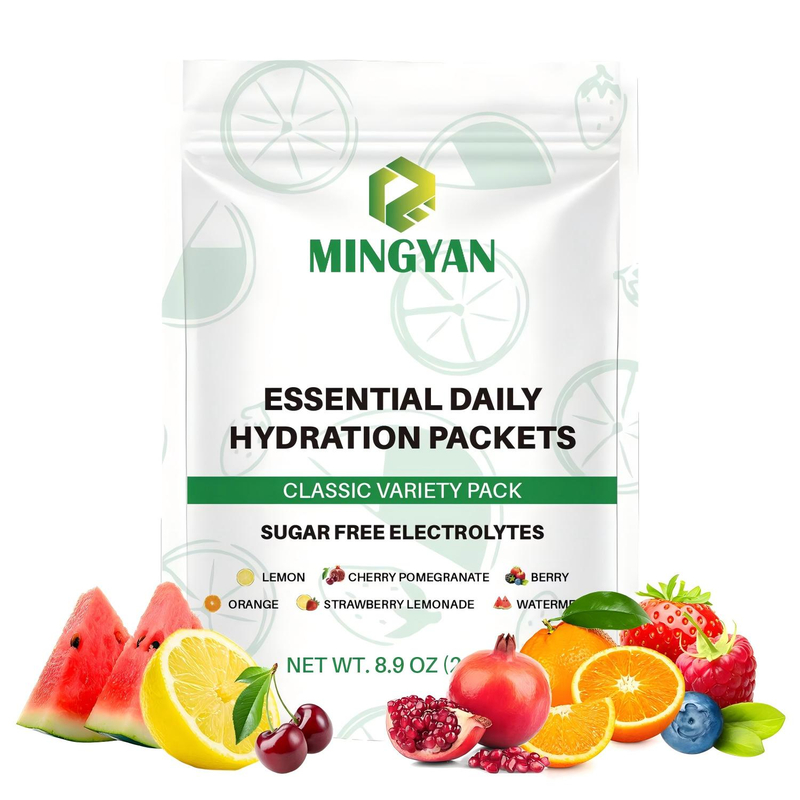
MINGYAN currently supports powder projects in canisters, resealable pouches, stick packs, sachets and bulk packaging. The best format still depends on the serving, powder behavior, commercial channel and project requirements rather than one universal powder package.
If an expiration, best-by or similar shelf-life date will be used, ask what data or technical basis support that date for the actual formula and commercial package. Do not assume that a shelf life from another electrolyte powder transfers unchanged to a different serving, flavor system or package.
A certificate of analysis is useful, but it is one document within a larger quality system. Manufacturer evaluation should establish how component specifications, in-process controls, finished-product specifications, testing or examination and quality-control review connect to the product being quoted.
For U.S. dietary-supplement manufacturing, a component that is a dietary ingredient generally requires at least one appropriate identity test or examination before use unless the specific FDA exemption procedure applies. For other applicable component specifications, supplier COA reliance is possible only when the required supplier-qualification and COA-reliability conditions are met.
Some controls can live in component records, in-process records, finished-product testing, packaging records or other quality documentation. Define the customer-facing COA and document scope you actually need, then confirm how those documents connect to the approved specification.
A manufacturer can use an appropriate verification strategy that selects finished-product specifications capable of demonstrating that its production and process-control system is producing product that meets all approved specifications, supported by documented rationale and quality-control review. Ask the manufacturer to explain which specifications are verified at the component, in-process and finished-product stages and why that combination is appropriate for the electrolyte formula.
Applicable master manufacturing records, batch production records, component records and quality-control documentation.
Audit evidence, controlled summaries, redacted examples or other information can be reviewed according to the qualification and confidentiality arrangement.
Approved specifications, batch COA or release information, agreed testing records, traceability information and other project documents.
MINGYAN currently lists GMP, HACCP and ISO 22000:2018 credentials together with FDA food-facility registration status for applicable activities. When evaluating any manufacturer, confirm the current scope and validity of the credentials relevant to your project.
FDA facility registration should not be described as FDA approval or certification of the manufacturer or its dietary supplements. Registration is a regulatory status; product quality still has to be demonstrated through the applicable manufacturing and quality controls.
A development sample lets the brand evaluate the product concept before bulk production. It is not evidence that every future commercial batch will behave identically.
flavor, sweetness, acidity and aftertaste;
serving mass and preparation instructions;
mixing appearance and dispersibility;
initial powder texture and handling;
whether the product direction matches the brief.
commercial-scale process repeatability;
future-batch conformity;
commercial shelf life;
production-line fill performance;
the complete batch-release system.
Scale-up can change mixing time, material handling, environmental exposure, equipment interaction and filling behavior. The manufacturer should identify which characteristics need to be reconfirmed when the approved development formula moves to the commercial process.
MINGYAN currently operates two powder production lines with powder output exceeding 50,000 units per day. Actual project capacity and production scheduling still depend on serving size, formula and packaging format, so a published capacity figure should be treated as a capability signal rather than a commitment for an individual SKU.
For a U.S. electrolyte supplement, Serving Size, sodium, potassium, magnesium and other applicable nutrient amounts should reconcile with the approved formula. The mineral source ingredients, flavor system, sweeteners and other non-declared components should also be handled correctly in the ingredient statement and other label sections.
Ask which approved formula and specification revision the final artwork will be checked against and who verifies that Serving Size, nutrient amounts, Directions and package count describe the commercial product being manufactured.
For qualifying U.S. structure/function and related claims under section 403(r)(6), the responsible manufacturer, packer or distributor marketing the claim must meet the applicable requirements, including truthful and non-misleading substantiation, the required disclaimer and FDA notification no later than 30 days after first marketing the dietary supplement with the claim.
In a private-label or contract-manufacturing relationship, define which party is responsible for claim substantiation, final label review and required regulatory submissions instead of assuming that the commercial model itself assigns those responsibilities.
Custom powder projects can evaluate different mineral targets and source ingredients, flavors, sweetness and acidity, serving specifications and packaging formats according to formulation feasibility and target-market requirements.
Our powder manufacturing capabilities cover canisters, resealable pouches, stick packs, sachets and bulk packaging, while our OEM / ODM process can support projects from formula review or development through sampling, packaging, manufacturing and delivery coordination.
Use one scoring rule for every candidate: 0 = not demonstrated, 1 = partially demonstrated or still open, 2 = clearly demonstrated for the proposed product. This scorecard is a procurement tool, not a regulatory certification.
Ask for the documents needed to evaluate and manage the specific project rather than demanding every internal manufacturing record. Some documents should be delivered with the commercial product; others may be reviewed only during qualification or audit.
Destination market / sales channel: ______________________________
Product positioning: ______________________________
Target sodium amount per serving: ______________________________ / TBD
Target potassium amount per serving: ______________________________ / TBD
Target magnesium amount per serving: ______________________________ / TBD
Required / preferred mineral source ingredients: ______________________________ / request recommendation
Other active ingredients: ______________________________
Serving mass / format: ______________________________ / TBD
Mixing volume and target appearance: ______________________________
Flavor direction: ______________________________
Sweetener / sugar requirements: ______________________________
Acidity / sensory requirements: ______________________________
Packaging format: □ canister □ pouch □ stick pack □ sachet □ bulk □ request recommendation
Package count / number of servings: ______________________________
Required product specifications / testing expectations: ______________________________
Required customer-facing documents: ______________________________
Desired claims for responsibility review: ______________________________
Stability / shelf-life requirement: ______________________________
Estimated first order / annual range: ______________________________
Open technical items requiring manufacturer recommendation: ______________________________
1. Which source ingredient will provide each declared electrolyte nutrient, and what specification basis will be used in the manufacturing calculation?
2. How will the proposed nutrient targets, total serving mass and package format be reconciled before sampling?
3. How will flavor, sweetness, acidity and aftertaste be developed around the complete mineral system?
4. What mixing endpoint will the sample be designed to meet, and under which preparation conditions will it be evaluated?
5. Which raw-material or finished-blend characteristics are most important to flow, moisture sensitivity, caking and filling for this formula?
6. Which packaging controls will be used for the proposed canister, pouch, stick pack or sachet?
7. How do component specifications, in-process controls and finished-product verification work together for this formula?
8. Which batch-level documents will our brand receive, and what additional records can be reviewed during qualification?
9. Which characteristics will be reconfirmed when the approved sample moves to commercial-scale production?
10. Which formula, raw-material, packaging or specification changes trigger customer notification or review?
Start by normalizing the formula: nutrient amounts per serving, mineral source ingredients, total serving mass, flavor system, mixing target, packaging format and required quality-document scope. Price becomes useful after those variables describe the same proposed product.
No. The appropriate sodium, potassium, magnesium and other nutrient amounts depend on the product concept, Serving Size, directions, target market and complete formula. Manufacturer evaluation should focus on whether the proposed amounts and source ingredients are clearly defined and technically workable.
For U.S. dietary-supplement nutrition labeling, magnesium is declared by the amount of magnesium in the serving rather than the total mass of the magnesium source ingredient. The source can be identified separately, such as Magnesium (as magnesium citrate), when appropriate.
No. Caking risk depends on the complete formula, raw materials, environmental exposure, processing and packaging. An anti-caking ingredient can be one formulation option when appropriate, but it should not be added automatically without evaluating the finished blend and product requirements.
No. The intended mixing behavior should follow the product concept. Some formulas are designed for clear solutions, while others may be acceptable as dispersions or suspensions. Define the target before judging the development sample.
Ask how the manufacturer controls and verifies the finished product's approved composition. The answer may involve raw-material specifications, mixing controls, in-process monitoring, sampling and finished-product tests or examinations. A master manufacturing record or batch production record alone is not proof of blend uniformity.
Choose the format from the serving mass, consumer-use plan, filling requirements, package count and moisture-protection needs. Stick packs and sachets provide pre-measured servings, while canisters and pouches support multi-serving products, but none is automatically the best format for every electrolyte formula.
No. A COA can report agreed batch results, but manufacturer qualification should also consider component controls, incoming dietary-ingredient identity verification, in-process controls, finished-product verification, traceability, packaging and the quality-control system behind batch release.
Those are important manufacturing records in a U.S. Part 111 system, but complete records are not automatically customer deliverables and can contain proprietary information. Confirm that the required system exists, agree what evidence can be reviewed during qualification and define the batch documentation your brand will receive.
Treat it as a capability indicator until the manufacturer has reviewed your formula, serving mass, packaging format, testing requirements and schedule. The commercial commitment should be based on the actual project rather than a general line-capacity figure.
Tell us the destination market, target sodium, potassium and magnesium amounts, preferred mineral sources if already selected, serving mass, flavor direction, mixing target, packaging format, estimated quantity and required testing or batch documents. We can identify which parts of the product are ready for quotation and which still require formula, sample or process development.
Send Your Electrolyte Powder Brief →