Views: 0 Author: Site Editor Publish Time: 2026-09-09 Origin: Site
A successful private label Ceylon cinnamon supplement starts with one consistent product definition: the correct Ceylon species, a defined commercial extract, a clear extract amount and serving basis, a feasible dosage form, an approved package and an agreed quality-document scope.
The most expensive private-label problems usually begin when one of those decisions is left implicit. A product page may say “12:1 Ceylon cinnamon” or show a large herbal-equivalent number, but quotation and manufacturing require a more precise question: what exactly will be in the finished serving, and which specification controls it?
A private-label Ceylon cinnamon project can begin from several different places. A brand may already like an existing product direction and only need a defined configuration and branded packaging. Another customer may have an approved raw-material or finished-product specification. A third may have only a market position—for example, a Ceylon cinnamon softgel for a particular sales channel—and still need technical development.
Those starting points matter more than whether a project is casually described as “private label,” “OEM” or “ODM.” The terminology overlaps across the supplement industry. What matters operationally is which parts of the product are already fixed, which still require development and which party will approve each decision before production.
Begin by confirming which existing characteristics remain fixed and which can change: extract concentration, serving configuration, shell, softgel size, color, package count, label and packaging.
Begin with technical review: botanical identity, actual extract amount, dosage-form feasibility, label basis, required testing, package and buyer-facing documentation.
Begin by defining species, product positioning, dosage form, serving target, desired claims, packaging and the commercial constraints the formulation has to satisfy.
Our OEM / ODM supplement solutions can begin from any of these points. Formula status, technical development requirements, target market, packaging, quantity and launch planning determine the actual cooperation scope.
A useful brief explains what the finished product has to accomplish commercially before it dictates technical details that have not yet been evaluated. The goal is to give the manufacturer enough fixed inputs to develop one product rather than make assumptions about several possible products.
If the product is positioned specifically as Ceylon cinnamon, the botanical identity belongs in the technical specification—not only in front-label marketing. The raw material should identify Cinnamomum verum as the intended species and state the relevant plant part and commercial preparation.
Cinnamomum verum, with relevant supplier synonym information where needed.
Bark or another defined part should be written into the approved commercial ingredient definition.
Dry extract, liquid extract or another processed form needs its own specification rather than being represented simply as “cinnamon.”
The identity-verification approach should be appropriate to the material being purchased. Intact bark, powdered botanical material and concentrated extracts do not necessarily present the same analytical options. For U.S. dietary-supplement manufacturing, a component that is a dietary ingredient generally requires at least one appropriate identity test or examination before use unless the specific regulatory exemption process applies.
If the approved product is built around Cinnamomum verum, replacing that raw material with another cinnamon species should trigger technical and label review rather than being treated as a routine purchasing substitution.
Ceylon cinnamon is generally associated with a much lower coumarin profile than cassia, but the species name does not create a universal zero-coumarin guarantee. If coumarin is relevant to the target market, product positioning or project risk assessment, define the acceptance criterion and analytical method in the raw-material or finished-product control strategy.
That decision should be project-specific. A coumarin result can be valuable evidence when the specification requires it, but it should not be inserted into every Ceylon project merely because another cinnamon product uses that test.
These three numbers often appear together in botanical sales materials but do different jobs. Keeping them separate is essential before formulation, Supplement Facts artwork and supplier quotations can describe the same product.
A ratio such as 12:1 describes a relationship between the starting botanical material and the commercial extract under a defined basis.
This expresses how much starting cinnamon material a defined quantity of extract represents. It is not automatically the mass of extract in one softgel or serving.
This is the mass of commercial extract actually used in the approved dosage unit or serving.
For a dried botanical extract from which the solvent has been removed, the quantitative Supplement Facts amount is the dried-extract weight. An extract ratio or herbal-equivalent statement may provide additional product context, but it should not replace the actual dietary-ingredient quantity required on the panel.
Do not reverse-calculate a production formula from a marketing ratio and herbal equivalent unless the approved raw-material and finished-product specifications establish the calculation basis. The commercial formula should provide the number instead of forcing artwork to invent it.
A Ceylon cinnamon softgel is not defined by the botanical name alone. The extract, carrier system, internal fill behavior, shell and serving target have to work as one dosage-form system.
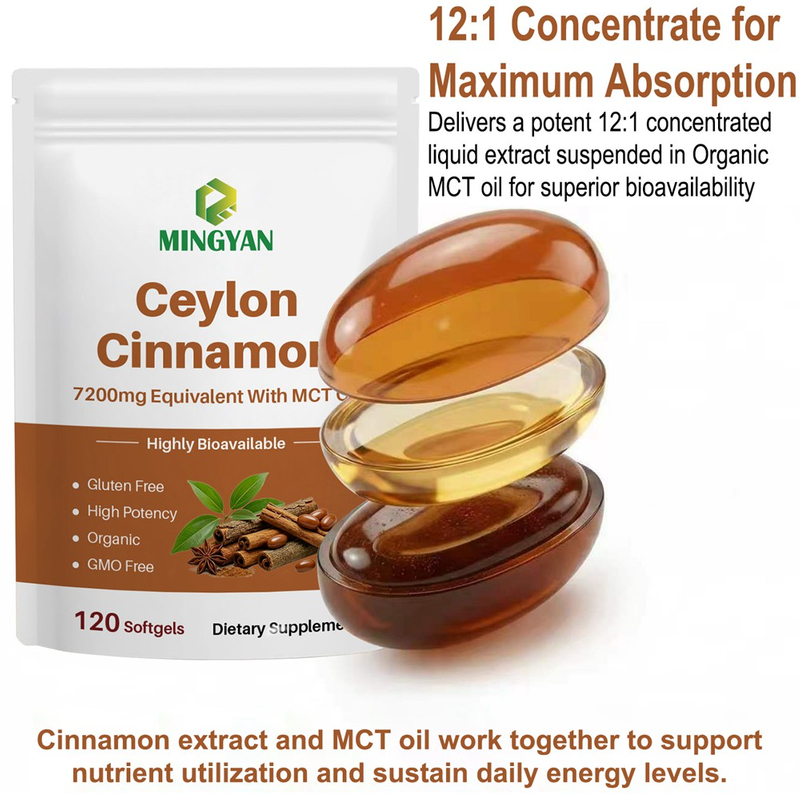
Our current Ceylon Cinnamon Extract Softgel uses Ceylon cinnamon bark extract with MCT oil in an oil-based softgel system. During custom development, extract concentration, carrier volume, fill viscosity, shell compatibility and softgel size are evaluated together for the actual project.
If a hard capsule is preferred, the engineering question changes. A suitable dry extract would instead be evaluated as part of the complete powder blend for mass, density, flow, capsule volume and filling consistency. MINGYAN also supports hard-capsule manufacturing when the ingredient and serving configuration fit that route.
Serving design is not just a marketing decision and not just a formulation decision. It connects the approved extract amount to the physical dosage unit and the commercial package.
Package count ÷ units per serving = servings per container.
Actual extract per dosage unit × units per serving = extract amount per serving, when the approved identical-unit formula is configured that way.
If any of those values are still open, keep them marked as development decisions. It is easier to change a serving configuration before artwork and package dimensions are approved than after commercial specifications have been issued.
A development sample is important because it gives the brand a physical product to review. It should be evaluated against the approved development brief rather than against an informal expectation.
softgel or capsule appearance;
unit size and physical presentation;
initial sensory characteristics;
package presentation where a packaging sample is included;
whether the development direction matches the approved brief.
commercial shelf life;
future-batch conformity;
commercial-scale process repeatability;
that every proposed label claim is substantiated;
the complete finished-product release strategy.
Record the approved sample characteristics and the project specification version used for the review. If formulation values change after the sample is approved, decide whether the change is minor enough to document or significant enough to require another development review.
Artwork should follow the approved formula and serving basis. For a Ceylon cinnamon product, that means the botanical identity, actual dietary-ingredient amount, Serving Size and package count should agree with the commercial specification.
The actual dietary-ingredient amount on Supplement Facts should not be replaced by a large herbal-equivalent figure or an extract ratio.
Ceylon species identity can be an accurate product statement when supported. It does not independently substantiate a blood-sugar, weight-management or other health outcome claim.
For qualifying U.S. structure/function and related claims under section 403(r)(6), the responsible firm marketing the claim needs substantiation that the statement is truthful and not misleading, the required disclaimer and FDA notification no later than 30 days after first marketing the dietary supplement with the claim.
Statements such as organic, non-GMO, gluten-free, vegan or other market-positioning claims should only appear when the relevant ingredient, process or certification documentation supports them. Flag these requirements before sourcing and packaging are locked.
U.S. structure/function claim requirements →
The commercial package is part of the finished product definition. Container type, closure, softgel count, label dimensions and any outer packaging should be confirmed before final production artwork and stability statements are approved.
U.S. dietary-supplement CGMP rules do not generally require an expiration date. If the brand chooses to use one, the date should have appropriate supporting data rather than being copied from a different formula or package.
A private-label customer should understand what documents support each production batch, but it is important to separate manufacturing records the facility is required to maintain from the documents the customer is contractually entitled to receive.
For U.S. CGMP operations, this includes applicable master manufacturing records, batch production records, component and quality-control records.
Qualification can establish how records, specifications, traceability, quality review and batch release are controlled, including appropriate audit or confidentiality arrangements.
This may include approved specifications, batch COA or release information, testing documentation, traceability information and other records defined in the project agreement.
A manufacturer may treat full production records as confidential. Confirm that the required record system exists and agree what can be reviewed through qualification or audit and what batch documentation will actually be delivered to your brand. Where useful, redacted examples or controlled summaries can be discussed under appropriate confidentiality arrangements.
For U.S. operations, incoming dietary-ingredient identity verification, component controls, in-process monitoring and finished-product verification form one quality system. A supplier COA is useful evidence, but it is not a substitute for the manufacturer's entire component-qualification and release system.
Commercial production should scale the approved product rather than reopen the product definition. Before the first bulk run, formula, raw material, serving configuration, package, artwork, release specification and buyer-facing document scope should all have controlled versions.
The first production batch confirms that the development decisions can be executed at commercial scale. Ongoing supplier performance then depends on repeatability, change communication and whether later batches continue to meet the same approved product definition.
This current product can serve as a starting configuration for a private-label project. Customization may include formula concentration, carrier system where technically suitable, shell, size, color, serving configuration, package count and branded packaging.
The product reference is not a substitute for the final project specification. If the formula, serving or package changes, the technical and label values should be reconfirmed for the customized product.
Send the same technical brief to every manufacturer you want to compare. Mark unresolved fields as TBD rather than letting each supplier make a different assumption.
Destination market / sales channel: ______________________________
Project starting point: □ existing product direction □ own specification □ custom development
Botanical identity: Cinnamomum verum / ______________________________
Plant part: ______________________________
Commercial extract / physical form: ______________________________
Identity-verification requirement: ______________________________
Extract ratio + basis: ______________________________
Actual extract amount per unit / serving: ______________________________ / TBD
Herbal equivalent, if used: ______________________________
Coumarin requirement, if applicable: ______________________________ / TBD after risk review
Preferred dosage form: □ softgel □ capsule □ request recommendation
Carrier / fill requirements, if already fixed: ______________________________
Serving Size / units per serving: ______________________________
Package count / packaging: ______________________________
Desired claims for review: ______________________________
Optional certification / label statements: ______________________________
Required quality / batch documents: ______________________________
Species / formula / packaging change-notification expectations: ______________________________
Estimated quantity range: ______________________________
Open technical items requiring manufacturer recommendation: ______________________________
Yes. An existing product direction can be used as the starting point for a branded project, subject to the available customization scope and target-market requirements. The final formula, serving information, package count and label still need an approved commercial specification.
The terms overlap across manufacturers, so define the project scope instead of relying on the label alone. The practical question is whether you are beginning with an existing product direction, your own specification or an open concept that still requires formulation and product development.
Yes, when Ceylon species identity is part of the approved ingredient. The raw-material specification should define the botanical identity and plant part clearly. Consumer-facing label terminology can then be reviewed separately for the destination market.
It describes a concentration relationship between starting botanical material and extract under a defined manufacturing basis. It does not independently tell you the actual extract amount in a softgel, the herbal equivalent per serving or the amount that belongs on Supplement Facts.
No. A herbal equivalent represents the amount of original botanical material associated with the extract under the stated basis. Our current Ceylon cinnamon softgel displays a 7,200 mg herbal equivalent per serving, while the actual extract amount and Serving Size follow the final approved product specification.
Not as a universal rule for every project. Whether coumarin belongs in the raw-material or finished-product test plan depends on the selected ingredient, supplier controls, destination market, product positioning and project risk assessment. When a coumarin criterion is required, define the acceptance limit and analytical method in the specification.
There is no universal answer. Serving Size should be developed together with the actual extract amount, total fill, softgel size, directions and commercial package. A one-unit serving should not be assumed simply because it looks simpler on the front label.
A U.S. dietary-supplement manufacturer operating under Part 111 must maintain applicable batch production records, but the full record is not automatically a customer deliverable and can contain proprietary information. During qualification, confirm that the record system exists and agree what batch-level documents, testing information and traceability evidence your brand will receive.
U.S. dietary-supplement CGMP rules do not generally require an expiration date. If your finished product uses an expiration, best-by or similar date, the date should be supported by appropriate data for the actual formula and commercial package.
Tell us the destination market, Ceylon cinnamon specification or reference product, dosage form, serving target, desired claims, packaging and estimated quantity. We can identify which parts of the project are ready for quotation and which still require formulation, sample or specification development.
Send Your Ceylon Cinnamon Brief →