Views: 0 Author: Site Editor Publish Time: 2026-08-31 Origin: Site
For a supplement brand developing a 600 mg NAC product, choosing between a hard capsule and a softgel changes more than the outer shell. It changes the formulation architecture, the physical form in which the ingredients are handled, the manufacturing pathway, the variables that must be controlled during scale-up, and the questions that need to be answered before the product specification can be approved.
That is why the NAC capsule vs softgel decision should not begin with assumptions about which format looks more advanced or which one consumers might prefer. It should begin with the formula.
A hard capsule generally follows dry-fill formulation logic. A softgel requires a compatible liquid, dispersion, suspension, or semisolid fill system that must work together with the shell. For NAC, that distinction becomes especially important when the softgel concept includes an oil carrier.
A conventional hard capsule usually places a suitable powder, granule, or dry blend inside a two-piece shell. A softgel encloses a liquid or semisolid fill inside a formed and sealed soft shell. These are not simply two packaging choices for the same formula.
With a hard capsule, the development team is primarily asking whether the complete dry blend can be prepared, handled, filled, and delivered within an acceptable capsule and serving configuration.
With a softgel, the development team must additionally determine how each active ingredient exists within the carrier-based fill, whether the fill remains physically uniform, whether its viscosity and loading are suitable for encapsulation, and whether the fill and shell remain compatible as a finished dosage-form system.
| Decision Dimension | NAC Hard Capsule | NAC Softgel |
|---|---|---|
| Formulation architecture | Primarily dry-fill formulation logic | Carrier-based liquid, dispersion, suspension, or semisolid formulation logic |
| Physical state of the active | NAC is generally incorporated into a dry powder blend | The formulation must establish whether NAC and other actives are dissolved, dispersed, suspended, or otherwise incorporated |
| 600 mg fill constraint | Total powder mass, blend density, and available capsule volume | Active loading plus carrier and total fill-system volume |
| Critical physical behavior | Flow, segregation, packing, blend uniformity, fill consistency | Viscosity, dispersion or suspension uniformity, sedimentation or separation where relevant, dosing consistency |
| Formula-change sensitivity | Adding ingredients can change blend volume, density, flow, and capsule-size feasibility | Adding ingredients can change physical state, carrier requirement, viscosity, loading, and shell-fill behavior |
| Manufacturing pathway | Blend preparation → filling → inspection → packaging | Fill preparation → encapsulation and sealing → drying or conditioning where applicable → inspection → packaging |
| Scale-up watch points | Powder handling, flow, segregation, fill-weight consistency | Fill uniformity, viscosity, settling or separation where relevant, encapsulation consistency, shell-fill interaction |
| Relationship to shell | Shell surrounds the dry fill and still requires formula and storage compatibility review | Shell and internal fill behave as a more tightly coupled formulation system |
| Packaging dependency | Packaging should protect the finished capsule against relevant environmental conditions | Packaging review should account for the fill, shell, storage environment, and their combined stability requirements |
| Serving configuration | Powder volume may require a larger capsule or multiple capsules per serving | Total active-plus-carrier volume may affect softgel size or units per serving |
| Commercial positioning | Familiar conventional supplement format suited to many dry-fill concepts | Can provide a distinct sealed dosage-form presentation when that format fits the formulation and brand brief |
A 600 mg NAC supplement does not automatically require one capsule, one softgel, or a particular dosage-unit size. The 600 mg figure identifies an active-strength target only after the brand defines whether it applies per dosage unit or per serving.
600 mg NAC does not necessarily equal 600 mg total fill.
A hard capsule may also contain excipients or other actives. A softgel may require a carrier system plus additional formulation components. Dosage-form feasibility therefore depends on the complete formulation rather than the NAC declaration alone.
For hard-capsule projects, the relevant question is whether the complete dry blend can achieve the desired loading within an acceptable capsule size and serving configuration. For a deeper review of that pathway, see our hard capsule manufacturing information.
If our separate NAC 600 mg capsule sourcing guide is published as a live page, it should also be linked here so buyers who need detailed hard-capsule specification guidance can move into that topic without duplicating it in this comparison article.
A hard capsule may be the logical first pathway when the complete formulation can be developed as a processable dry blend and delivered within an acceptable dosage-unit and serving format.
The main decision points are relatively focused: Does the complete formula fit? Can the powder blend be filled consistently? Can acceptable blend uniformity be maintained? Does the required capsule size make commercial sense? Is the proposed number of capsules per serving acceptable for the product brief?
Factors that can make the hard-capsule pathway less practical include excessive total fill volume, poor powder flow, difficult blend uniformity, an undesirable capsule size, or a serving configuration that no longer fits the intended commercial concept.
Best fit: The product can be developed as a suitable dry-fill formulation.
Key watch point: The complete blend—not only the NAC amount—must fit and process consistently.
Confirm before choosing: Total fill volume, powder processability, capsule size, and serving configuration.
This is where the comparison becomes more specific to NAC.
Public chemical reference data describe N-Acetyl-L-Cysteine as a crystalline solid with substantial solubility in water. That information is useful, but it does not establish how NAC behaves inside a specific MCT-oil, coconut-oil, or other carrier-based softgel formulation.
In particular, aqueous solubility cannot be used to conclude either that NAC will dissolve in an oil carrier or that an oil-based NAC softgel is technically unsuitable. A softgel can contain active ingredients as solutions, dispersions, suspensions, or other appropriately engineered fill systems.
For a brand evaluating a NAC 600 mg softgel, the real formulation question is therefore:
That answer must come from the actual formula and development work—not from the words “softgel,” “MCT oil,” or “coconut oil” on the product brief.
For any carrier-based NAC softgel concept, the formulation team should intentionally define the physical state of NAC and each additional active. If a material is not molecularly dissolved in the carrier system, its dispersion or suspension behavior becomes part of the dosage-form design.
This affects much more than terminology. It changes what needs to be evaluated during processing, encapsulation, sampling, stability review, and finished-product control.
If solid material is present in a dispersion or suspension, it needs to remain sufficiently and reproducibly distributed while fill material is being prepared and dosed. The technical question is whether the active concentration delivered to one softgel remains representative of the approved fill throughout production.
Settling is not automatically a problem in every suspension system, but it is a variable that should be evaluated where technically relevant. Particle characteristics, density differences, carrier properties, viscosity, agitation, hold time, and process conditions can influence how a suspended system behaves.
A buyer does not need to prescribe the internal process. It should ask whether physical uniformity has been considered and how the finished formulation will be shown to meet the intended specification.
Where undissolved solids are present, particle properties can influence suspension behavior, viscosity, processing, and the ability to dose the fill consistently. The relevant particle characteristics are formula-specific and should be established during development rather than assumed from generic NAC raw-material information.
A softgel must accommodate not only the NAC target but also the carrier and any additional active or functional formulation components. A 600 mg NAC softgel therefore has a different fill-volume calculation from a 600 mg dry-capsule concept.
If the active-plus-carrier system creates an impractical total fill volume, the formulation, concentration, softgel size, or serving configuration may need to be reassessed.
Softgel suspension research shows why rheology matters: fill viscosity can affect the ability to move and dose material consistently during encapsulation, while suspension uniformity is relevant to content consistency.
The appropriate viscosity is not a universal number. It depends on the actual fill system and manufacturing process. For procurement purposes, the important question is whether the final formulation has been evaluated for suitable fill behavior under the intended production conditions.
A softgel shell is not simply a container placed around a finished liquid. Published softgel literature emphasizes interactions between shell composition, fill composition, manufacturing conditions, and storage environment.
The project therefore needs to evaluate whether the selected fill and shell remain compatible through manufacturing and the intended product life. The relevant questions can include moisture exchange, ingredient migration, shell mechanical behavior, and other formula-specific interactions.
Neither an oil carrier nor a softgel shell automatically creates superior stability. Finished-product stability depends on the actual formula, physical state of the ingredients, shell, storage conditions, environmental exposure, and container-closure system.
The brand should therefore ask whether the proposed commercial formula and final packaging have appropriate shelf-life support rather than assuming that the dosage form itself guarantees stability.
You can review how we approach carrier selection, active dispersion, fill viscosity, shell compatibility, serving format, and packaging across our private label softgel manufacturing projects.
Best fit: The product brief is intentionally moving toward a technically suitable carrier-based, liquid, dispersion, suspension, or semisolid fill system.
Key watch point: Active loading, physical distribution, viscosity, and shell-fill behavior must work together.
Confirm before choosing: How each active is incorporated, whether the fill remains sufficiently uniform, total fill volume, encapsulation feasibility, shell compatibility, stability, and packaging.
The dosage-form name alone is not evidence that an NAC softgel provides greater absorption or bioavailability than an NAC hard capsule.
Relative bioavailability is a formulation-specific question. It can be influenced by the physical and chemical properties of the ingredient, the way the active is incorporated, the delivery system, release or dissolution behavior, and the actual finished formulation being studied.
Published NAC pharmacokinetic literature also emphasizes that oral bioavailability should be established for the relevant NAC formulation. Studies comparing different oral NAC products demonstrate the importance of evaluating actual formulations; they do not constitute evidence that softgels as a category are superior to hard capsules.
The same rule applies to carrier oils. The presence of MCT oil or coconut oil in an NAC softgel concept does not, by itself, demonstrate increased NAC absorption.
A comparative bioavailability claim should therefore be made only when appropriate evidence supports the specific finished formulations being compared.
At this point, the decision can be narrowed to a practical development pathway.
The formula is primarily suited to a dry-fill system.
The complete blend fits an acceptable capsule format.
Powder properties can support consistent filling.
The resulting capsule size and serving configuration fit the commercial brief.
The product brief is intentionally built around a compatible carrier-based or liquid-fill pathway.
A distinct sealed softgel presentation supports the desired product concept.
The active ingredients can be incorporated with acceptable physical uniformity.
The fill and shell can be developed as one compatible dosage-form system.
Define the complete formulation—not just “600 mg NAC.”
Assess dosage-unit and serving feasibility.
Identify the key scale-up risks for the selected pathway.
Confirm finished-product quality, stability, and packaging requirements.
Compare the development and commercial scope before approving the dosage form.
If the development decision is intentionally moving toward a carrier-based softgel system, a brand does not necessarily need to begin with an abstract formulation concept.
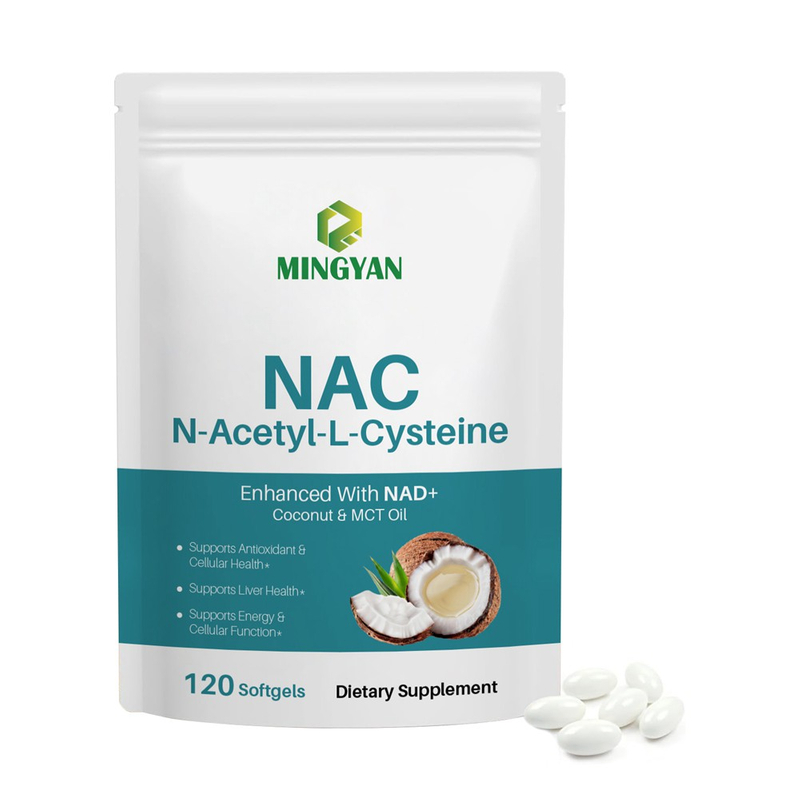
We currently offer an NAC softgel product concept combining NAC, NAD+, coconut oil, and MCT oil. The displayed product uses a 600 mg NAC formula option and is presented as 120 softgels in a resealable pouch.
This provides a practical starting point for brands intentionally evaluating the softgel pathway rather than developing a softgel concept from zero.
Softgel dosage form
NAC, NAD+, coconut oil, and MCT oil formula context
Displayed 600 mg NAC formula option
Displayed 120-softgel count
Resealable pouch presentation
Private label, OEM, and ODM availability
Formula, strength, count, shell, packaging, and label customization can be discussed
The final ingredient quantities, physical state of the actives in the fill, carrier ratios, particle characteristics where relevant, viscosity, dispersion or suspension behavior, shell-fill compatibility, manufacturing parameters, finished-product specifications, stability support, and final packaging should be evaluated for the approved commercial formulation.
This distinction is intentional. The existing product gives brands a real commercial softgel direction to evaluate, while formula-specific engineering review establishes exactly how that direction should be configured for the final project.
Dosage-form selection becomes particularly important when the initial NAC concept is likely to evolve.
In a hard capsule, adding another active ingredient can increase powder volume, alter density and flow, affect blend uniformity, and potentially change the required capsule size or number of capsules per serving.
In a softgel, a formula change can affect more than total fill mass. A new active may change whether the system behaves as a solution, dispersion, or suspension; alter viscosity or physical stability; require reconsideration of the carrier system; increase total fill volume; or change the relationship between the fill and shell.
This does not make one pathway universally more flexible than the other. It means that “Can we add this ingredient?” is a different engineering question depending on the selected dosage form.
Dosage-form selection does not replace finished-product quality requirements. Whichever pathway is selected, the final product needs an approved specification and appropriate manufacturing and quality controls.
For U.S.-market dietary supplements, 21 CFR Part 111 addresses component and finished-product specifications, dietary ingredient identity and verification, quality-control responsibilities, and packaging and labeling specifications.
A supplier COA can support part of the documentation package, but it does not represent the entire quality system. For this comparison decision, the key question is simpler: Can the manufacturer define and control the selected dosage form as a finished commercial product?
FDA currently maintains an enforcement-discretion policy for certain NAC-containing products labeled as dietary supplements that would otherwise be lawfully marketed and are not otherwise in violation of the FD&C Act. Enforcement discretion is not FDA approval or a blanket determination that every NAC product is compliant. U.S.-market formulation, labeling, claims, and CGMP requirements still require separate review.
An RFQ for this stage should help the manufacturer compare the two formulation pathways—not repeat a complete supplier-qualification questionnaire.
What is the target NAC amount per dosage unit and per serving?
What additional active ingredients are included?
Is the product intended to remain a dry blend, or is a carrier-based fill being considered?
What is the physical form of each active ingredient?
What total fill volume is expected for each pathway?
What could make the hard-capsule route impractical?
What could make the softgel route impractical?
What formulation or development work is required before each pathway can be approved?
What dosage-unit size is commercially acceptable?
Is one unit per serving preferred, or is a multi-unit serving acceptable?
What shell requirements or market-positioning requirements apply?
What packaging considerations differ between the proposed capsule and softgel configurations?
What shelf-life support is needed for the final formula and packaging?
How does each dosage form change the development scope?
What MOQ applies to the actual proposed formula and packaging?
What sampling or formulation-development work is required?
Which production or packaging variables materially affect unit cost?
What needs to be finalized before a formal quotation can be issued?
MOQ, development time, and unit cost should be compared using the real project rather than assumptions that softgels are always more expensive or that hard capsules are always simpler.
Once the development pathway has been selected, the next step is to convert the concept into an approved commercial specification.
Through our custom supplement OEM and ODM services, we support formula selection, custom formulation, sampling, dosage-form development, packaging, labeling coordination, manufacturing, and finished-product delivery.
For brands already leaning toward an NAC softgel, the existing NAC with NAD+, coconut oil, and MCT oil concept can serve as the starting point for project discussion. For brands that still need to compare hard-capsule and softgel feasibility, the project brief can be reviewed before the dosage form is locked.
The most useful conclusion to the NAC capsule vs softgel question is not that one format wins. It is that the two formats require different formulation logic.
Choose the hard-capsule pathway when the complete formulation works effectively as a dry-fill system and can be delivered in a commercially acceptable capsule and serving configuration.
Evaluate the softgel pathway when the product brief is intentionally moving toward a compatible carrier-based fill and the actives, carrier, fill behavior, shell, stability requirements, and packaging can be developed as one system.
1. Define the formula. NAC strength alone does not select the dosage form.
2. Identify the intended physical system. Dry blend or carrier-based fill?
3. Test dosage-unit feasibility. Review total fill volume, size, and serving configuration.
4. Identify pathway-specific risks. Powder handling for capsules; fill uniformity and shell-fill behavior for softgels.
5. Confirm stability and packaging requirements.
6. Then approve the dosage form and commercial specification.
If this framework points your project toward softgel development, our existing NAC softgel with MCT provides a real product format to review before deciding whether to use the displayed concept as a private label starting point or adapt it through a custom development project.
NAC is a crystalline compound with substantial aqueous solubility, but that fact alone does not determine its behavior in an oil-based softgel. For an MCT- or coconut-oil-containing fill, the formulation should establish whether NAC is dissolved, dispersed, suspended, or otherwise incorporated and whether the complete system can be manufactured consistently.
Softgel fill systems can contain suspended active ingredients when the formulation is technically suitable. For an NAC suspension concept, the development team should evaluate physical distribution, particle behavior, sedimentation where relevant, viscosity, active loading, encapsulation consistency, shell compatibility, and unit-to-unit content consistency.
The presence of MCT oil does not by itself prove improved NAC bioavailability. Relative bioavailability requires evidence relevant to the specific finished formulation and comparator.
Usually, the dosage-form change requires formulation review because the two formats use different fill architectures. A hard capsule may use a dry blend with capsule-specific excipients, while a softgel requires a compatible liquid, dispersion, suspension, or semisolid fill system. The commercial ingredient list may appear similar even when the manufacturing formulation is not interchangeable.
Possible constraints include excessive total powder volume, poor flow, blend-uniformity challenges, an undesirable capsule size, or a serving configuration that no longer fits the intended product brief.
Possible constraints include excessive active-plus-carrier fill volume, unsuitable physical behavior of the fill, inadequate distribution uniformity, problematic viscosity, settling or separation where relevant, shell-fill incompatibility, or a softgel size and serving configuration that do not meet the commercial brief.
The development work is different rather than universally greater. Softgel development typically requires evaluation of the carrier-based fill and its relationship with the shell, while hard-capsule development requires its own assessment of powder flow, blend uniformity, fill volume, and capsule-filling feasibility.
Start with the formulation brief. If the product is naturally being developed as a processable dry blend, a hard capsule may be the logical first pathway. If the commercial concept specifically calls for a compatible carrier-based fill, softgel development should be evaluated directly rather than designing a hard capsule first and converting it later.
No. Stability is formulation- and packaging-specific. Softgel stability depends on the fill, shell, their interaction, storage environment, and packaging, while hard capsules have their own formula, shell, moisture, and packaging considerations.
A switch should not be treated as a simple shell substitution. Moving from a dry-fill capsule to a softgel generally requires evaluation of a different fill architecture, carrier system, physical state of the actives, fill volume, shell compatibility, manufacturing process, and stability strategy.
If you are deciding between a hard capsule and softgel, share your target NAC strength, additional ingredients, preferred serving format, target market, packaging direction, and estimated order quantity with our team.
If your product brief is already leaning toward a carrier-based softgel, we can also review our existing NAC softgel concept as a practical starting point and discuss which formula, shell, count, packaging, and labeling requirements need to be confirmed for your project.
Discuss NAC Formula Feasibility and Request a Project Review →