Views: 0 Author: Site Editor Publish Time: 2026-09-08 Origin: Site
A private label aged garlic extract supplement becomes quotable when the preparation, ingredient amount, dosage form, serving configuration, packaging and quality requirements describe one consistent product.
The two decisions that deserve the earliest attention are the aged garlic raw-material definition and the meaning of the numbers in the brief. A 15:1 ratio, an aged-garlic equivalent and the physical extract weight are related concepts, but they are not interchangeable specifications.
A private label aged garlic extract supplements project is more than adding a logo to a botanical formula. The brand, manufacturer and quality team have to agree on what aged garlic material is being used, what the concentration figures mean, how much finished ingredient belongs in the product, which dosage form can carry it, and which specifications will define an acceptable commercial batch.
At MINGYAN, we treat those questions as linked development decisions. Some customers begin with an existing product direction and need branding and packaging support. Others arrive with their own formula or raw-material specification. Others have a target market and product concept but still need formulation and dosage-form development. The project scope should follow what is already defined rather than relying on a rigid industry label for “private label,” “OEM” or “ODM.”
Start by confirming which parts of the reference product will remain fixed and which elements—strength, shell, count, packaging or label—need customization.
Start with technical review, dosage-form feasibility, documentation requirements, packaging and manufacturing scope.
Start with preparation identity, desired marker strategy, serving target, dosage-form options and the claims or positioning the formula needs to support.
Our OEM and ODM supplement solutions are adapted around formula status, development requirements, target market, expected quantity and launch plan. The useful first question is therefore not “Which label does this project belong under?” but “Which technical and commercial decisions are already approved?”
A private label brief should not begin with a ratio alone. Botanical extracts routinely use several different quantitative expressions, and each answers a different question.
A ratio such as 15:1 describes a relationship between starting botanical material and extract under a defined manufacturing basis. It does not automatically state how much extract is in one softgel.
An equivalent expresses the amount of original garlic represented by the extract under the specified basis. It is not automatically the physical mass of extract in the dosage unit.
This is the quantity of commercial extract used in the formula. For U.S. labeling of a dried botanical extract, the dried-extract weight is the quantitative amount that matters on Supplement Facts.
A 15:1 ratio and a 500 mg original-herb equivalent can describe useful commercial information while still leaving the physical extract quantity undefined. Final formulation and labeling should use the approved raw-material specification rather than an assumed conversion.
The initial brief should also state the destination market, target dosage form, desired units per serving, package count, claims intent, packaging preference, estimated order quantity and any ingredient or shell restrictions that are already fixed.
“Aged garlic extract” should not be treated as interchangeable with every other garlic-derived ingredient. Published garlic-supplement research distinguishes aged garlic extract from dehydrated garlic powder, garlic oil and garlic oil macerate because processing changes the constituent profile.
Published AGE research commonly describes prolonged extraction and aging during which sulfur-containing constituents change over time. That research is useful for understanding the category, but a commercial project still needs the selected supplier to define the actual raw material being purchased.
S-allyl cysteine (SAC) is commonly associated with aged garlic extract characterization in published research, while other garlic preparations may use different marker systems such as alliin or allicin potential. A project should therefore specify the marker system actually being purchased rather than assume every garlic ingredient can be compared on one common scale.
For the deeper preparation and marker comparison, see our separate guide to aged garlic extract vs garlic extract. This page keeps the focus on turning the selected aged material into a commercial private-label product.
The words “aged garlic extract” do not automatically determine whether the finished product should be a softgel or a hard capsule. Dosage-form feasibility follows the physical form and formulation behavior of the commercial ingredient selected in Stage 2.
A suitable liquid, dispersion, suspension or other softgel-compatible system has to be evaluated for active loading, physical stability, viscosity, fill uniformity and shell-fill compatibility.
A dried extract can be evaluated with its excipient system, blend mass, bulk properties, capsule volume, flow and filling consistency.
MINGYAN supports both softgel manufacturing and capsule manufacturing. That allows us to begin with the approved commercial ingredient and serving target rather than force every aged garlic project into one preset format.
A private label aged garlic softgel is a formulation system, not simply an extract placed inside a shell. The physical form of the aged garlic ingredient and the rest of the fill determine what the softgel has to accommodate.
Softgel size and shape should follow the approved fill composition and fill volume. Fixing the physical unit before the formulation is feasible can create unnecessary sampling rounds or force the project into a compromised serving configuration.
The same principle applies to shell material and color. They are project specifications that should be confirmed after compatibility and serving requirements are understood, not simply selected from a packaging mood board.
Artwork should begin after the ingredient and serving basis are understood. That is especially important for botanical extracts because an extract ratio, herb equivalent and actual dried-extract weight can all appear in commercial communication while serving different purposes.
For a dried botanical extract in the U.S., the quantitative amount is the weight of the dried extract. A concentration ratio or herb-equivalent statement should not replace that required extract amount.
For qualifying U.S. structure/function claims, the responsible firm using the claim needs substantiation, the required disclaimer and the applicable FDA notification. Disease claims require a different regulatory analysis.
For qualifying structure/function and related claims under section 403(r)(6), the manufacturer, packer or distributor responsible for marketing the claim must have substantiation that the statement is truthful and not misleading and must notify FDA no later than 30 days after first marketing the dietary supplement with the claim. The label also needs the required disclaimer.
In a private-label relationship, brand and manufacturing teams should agree who owns claim substantiation, regulatory review and notification responsibilities before the claim appears in final artwork. Do not assume that choosing an OEM or private-label commercial model automatically assigns every regulatory responsibility to one party.
A development sample is useful because it turns a paper specification into something the brand can physically review. It does not prove every aspect of commercial production.
softgel or capsule appearance
unit size and handling
initial sensory characteristics
packaging presentation
whether the development direction matches the approved brief
full shelf-life support
future-batch conformity
commercial-scale filling performance
the complete finished-product release specification
that all label claims are substantiated
Review the sample against the approved project document: dosage form, unit dimensions, sensory expectations, package presentation and available analytical documentation. If a sample looks acceptable but the underlying ingredient or serving basis is still unclear, the project is not ready for artwork or scale-up.
Package count, container type, closure, storage presentation and label area all affect the finished project. Packaging that contacts the dietary supplement also has a direct quality role.
Product-contact packaging must have established specifications, be safe and suitable for its intended use, and must not be reactive, absorptive or otherwise adversely affect supplement safety or quality.
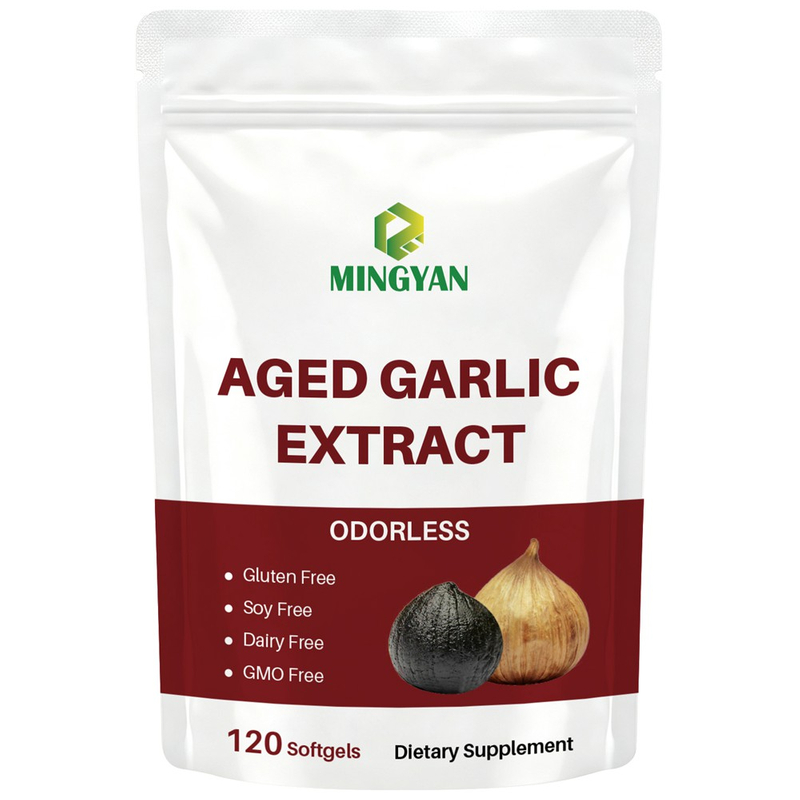
MINGYAN's current aged garlic extract softgel is displayed in a resealable stand-up pouch containing 120 softgels. Custom projects can evaluate different counts, pouches, bottles, labels and outer packaging. The final commercial pack should be confirmed before artwork dimensions and stability conclusions are locked.
For a U.S.-market dietary supplement, 21 CFR Part 111 separates specifications across multiple points in the manufacturing and packaging system. That is useful for procurement because it shows why one supplier COA is not the entire quality package.
Component specifications include identity and the controls needed to support finished-product purity, strength, composition and relevant contamination limits.
Specifications are established where control is necessary to help ensure the finished dietary supplement meets its approved requirements.
Part 111 requires label and product-contact packaging specifications as well as controls for finished packaged and labeled products.
Finished-product specifications cover identity, purity, strength, composition and relevant contamination limits.
Before a dietary-ingredient component is used, 21 CFR 111.75 generally requires at least one appropriate test or examination to verify its identity unless the specific regulatory exemption procedure applies. Supplier documentation remains important, but it does not turn a generic botanical description into a sufficiently defined aged garlic ingredient.
For a private label aged garlic extract project, the buyer-facing document package should be agreed during quotation. Depending on project needs, that may include approved specifications, batch COA or release information, testing documentation, traceability records and other agreed quality documents without requiring the manufacturer to disclose unrelated proprietary process information.
Scale-up tests whether the approved development decisions remain workable on the intended commercial process. Moving from development to production can expose differences in blending, material transfer, fill behavior, equipment settings and packaging-line performance.
The cleanest scale-up is therefore a confirmation exercise. If the raw material, serving configuration, dosage form, package or label is still moving at this stage, the project has returned to development rather than simply increasing batch size.
The product can be used as a starting configuration for a private-label project, while custom development may cover formula strength, softgel specification, shell, count, packaging and label. The physical formulation details for a custom product should be confirmed during development rather than inferred from the public concentration ratio.
The same principle applies to the odorless positioning. Our current product is designed as an odorless presentation, while final sensory characteristics for a customized project depend on the selected raw material and finished formula.
A quotation becomes comparable when every manufacturer receives the same definition. Use this template as the technical core of an aged garlic project brief.
Destination market / sales channel: ______________________________
Project starting point: □ existing product □ own specification □ custom development
Botanical identity / plant part: ______________________________
Aged garlic preparation / process reference: ______________________________
Physical form of commercial ingredient: ______________________________
Marker + target / range + analytical method: ______________________________
Extract ratio + calculation basis: ______________________________
Actual extract amount: ______________________________ / TBD after development
Garlic-equivalent statement, if used: ______________________________
Preferred dosage form: □ softgel □ capsule □ request recommendation
Serving Size / units per serving: ______________________________
Package count / packaging format: ______________________________
Desired claims for review: ______________________________
Testing / documentation requirements: ______________________________
Estimated order quantity: ______________________________
Open items requiring manufacturer recommendation: ______________________________
An open field is better than a guessed field. If extract amount, softgel fill, shell or packaging still depends on development work, mark it as TBD so the quotation makes that work visible.
It is an aged garlic supplement manufactured for sale under a customer's brand. Project scope can range from adapting an existing product direction to manufacturing from a customer specification or developing a customized formula. The commercial label “private label” does not by itself define who developed every part of the formula.
The terminology overlaps across the supplement industry, so define the scope instead of relying on the label alone. The important questions are whether the product starts from an existing formula, a customer-owned specification or an open concept that still requires formulation and development.
No. A 15:1 ratio describes a relationship between the starting botanical material and extract under a defined basis. It does not by itself state SAC content, clinical potency, actual extract weight per softgel or the amount that should appear as the dried-extract quantity on a U.S. Supplement Facts panel.
No. An original-herb equivalent and the physical mass of a botanical extract are different quantities. Our current aged garlic product displays the equivalent of 500 mg aged garlic per softgel; the approved project specification defines the actual commercial ingredient quantity.
No. Dosage form should follow the physical form and formulation behavior of the selected commercial ingredient. A suitable softgel-compatible system can be developed as a softgel, while a suitable dry extract can be evaluated for a conventional hard-capsule route.
Confirm the preparation identity, physical form, extract ratio and basis, actual extract amount, marker and analytical method, serving target, dosage-form path, contaminant requirements and the document package expected for the project.
The manufacturer, packer or distributor responsible for marketing a qualifying section 403(r)(6) claim must meet the applicable requirements, including substantiation, required disclaimer language and FDA notification. In a private-label project, the parties should agree responsibilities before final artwork is approved.
Timing depends on the starting specification, formulation work, sampling, packaging, artwork, testing and production scope. We therefore confirm project timing after reviewing the actual requirements rather than publishing a generic lead time that may not apply to the formula or package being developed.
Tell us the destination market, aged garlic specification or product reference, desired dosage form, serving target, packaging and estimated quantity. We can identify which parts of the project are already ready for quotation and which still need formulation, sampling or specification development.
Send an Aged Garlic Project Brief →