Views: 0 Author: Site Editor Publish Time: 2026-09-04 Origin: Site
A 600 mg NAC project is not “pick a capsule and ask for a quote.” It is a sequence of linked decisions: define the commercial brief, define what 600 mg means, choose a dosage-form pathway, prove feasibility, lock specifications and documentation, then complete packaging, labeling and scale-up.
The two decisions to resolve earliest are the basis of the 600 mg figure and the dosage-form pathway. If either stays vague, formulation, Supplement Facts, packaging and quotation can all move later.
A private label NAC supplement project has to connect commercial positioning with formulation, manufacturing, documentation and labeling. The brand may begin with a target such as “600 mg NAC,” a preferred softgel or capsule format and a retail count, but those are not yet a finished specification. The development process turns them into one.
MINGYAN supports private label, OEM and ODM supplement projects with formula selection or custom formulation, sampling, dosage-form development, manufacturing, packaging, quality coordination and delivery support. In practice, the scope matters more than the label attached to the cooperation model: two companies may both say “OEM” while expecting very different amounts of development work.
Private label, OEM and ODM are useful commercial terms, but they are not a universal technical taxonomy. The faster way to scope a project is to ask what you already have and what still needs to be developed.
Start with technical review, manufacturability, documentation requirements, packaging and quotation.
Start with formula scope, dosage-form selection, feasibility and sample development.
Start with the approved specification and required equivalence criteria—not by reverse-engineering the formula from front-label marketing.
MINGYAN's OEM and ODM supplement solutions can be adapted to different starting points. The useful first conversation is therefore about project scope: what is fixed, what is open, and what needs evidence before bulk production.
A vague request such as “quote a private label NAC supplement at 600 mg” forces the manufacturer to invent assumptions about the market, strength basis, dosage form, serving size, package and testing scope. A useful RFQ begins by reducing those assumptions.
“600 mg” is not a complete product specification. In a commercial project brief, that figure may be intended as a target per unit, a target per serving, or a reference formula option that still requires a final serving configuration. Those are different development instructions.
The formulation must place the target NAC quantity into one defined softgel or capsule while still accommodating the complete fill system.
The serving may contain one unit or multiple units. The serving size and amount per serving must reconcile on the finished label.
Useful during custom development, but it does not by itself establish a finished per-softgel or per-serving statement.
If a separately approved per-unit amount exists, it can be cross-checked against the unit count as a second calculation. Do not derive a per-unit claim from a formula option or from a front-label number that lacks an approved serving basis.
For the narrower capsule-sourcing question, see our NAC 600 mg capsule sourcing guide. This page stays focused on the end-to-end private-label development sequence.
A softgel and a two-piece hard capsule are different formulation systems. Choosing between them should follow the target formulation, serving configuration, packaging position and development priorities—not the assumption that one format is universally superior.
| Decision | Softgel pathway | Hard-capsule pathway |
|---|---|---|
| Typical fill system | Compatible liquid, dispersion, suspension or semisolid system. | Commonly powder or granulated fill; specialized systems may also exist. |
| Key feasibility variables | Active loading, carrier system, viscosity, particle behavior where relevant, fill uniformity and shell-fill compatibility. | Bulk/tapped density, flow, particle characteristics, excipient function, capsule volume and fill consistency. |
| Serving flexibility | Unit size and fill volume must be confirmed together with the target formula. | Capsule size and serving count can be adjusted when the target blend does not fit one unit. |
| Packaging / handling | The sealed one-piece dosage form and container-closure system are evaluated together. | Shell selection, closure integrity and container-closure system remain part of the finished-product design. |
| Best reason to choose it | The formula and brand concept benefit from a compatible softgel fill system. | The target can be delivered efficiently through a dry-fill capsule system. |
Does the active dissolve, disperse or suspend in the selected carrier system?
Can the required active loading fit the selected fill volume?
If particles remain present, what controls viscosity and sedimentation?
Is the fill compatible with the shell through the intended stability program?
Can commercial filling maintain unit-to-unit consistency?
What bulk and tapped density does the actual blend achieve?
Does the powder flow consistently on the intended filling equipment?
How do particle characteristics affect segregation and fill consistency?
Which excipients are functionally necessary?
Does the target serving fit one capsule or require a multi-capsule serving?
NAC is a water-soluble crystalline material, but raw-material handling should not be simplified to “NAC is hygroscopic.” Public physical-property data describe acetylcysteine as nonhygroscopic while noting oxidation in moist air. For a commercial project, use the approved raw-material specification and supplier storage/handling requirements instead of a generic moisture assumption.
MINGYAN supports both softgel manufacturing and capsule manufacturing, so the dosage-form discussion can begin with the formula and project target rather than with a single preset route.
Raw-material control is not just a COA request. The specification should define what material is acceptable for the intended project and which attributes matter for the selected dosage form.
A compendial monograph can provide a useful reference when applicable, but it does not automatically become the complete project specification. Physical attributes that drive manufacturability may need additional project-specific controls even when identity and assay conform.
Feasibility is where a commercial target becomes a manufacturable product. It should answer whether the intended formula can be filled consistently in the selected dosage form and which variables still need development work.
Confirm active loading, complete fill composition and available unit volume.
Evaluate flow or viscosity, particle behavior and filling consistency on the intended process route.
Identify the stability and packaging questions that must be answered before a shelf-life claim is supported.
For softgels, feasibility can involve carrier selection, solution/dispersion/suspension behavior, active loading, viscosity, fill uniformity and shell-fill compatibility. For hard capsules, it can involve blend density, flow, particle characteristics, excipient function, capsule volume and serving configuration. The correct outcome is not simply “sample looks good,” but a written development conclusion identifying what has been demonstrated and what remains open.
Commercial buyers need evidence that the process can deliver the agreed specification. Proprietary machine settings, temperatures or internal process limits are different from the product outcomes and documentation a buyer should define.
Serving configuration connects formulation with the consumer-facing product. The dosage form determines the available unit volume; the serving size determines how many units deliver the intended amount; the container count determines the number of servings in the package.
Separately confirm that Serving Size and unit count are consistent with the number of servings. If an approved per-unit NAC amount exists, it provides an additional cross-check. Do not mix “units per serving” into the amount-per-serving calculation a second time.
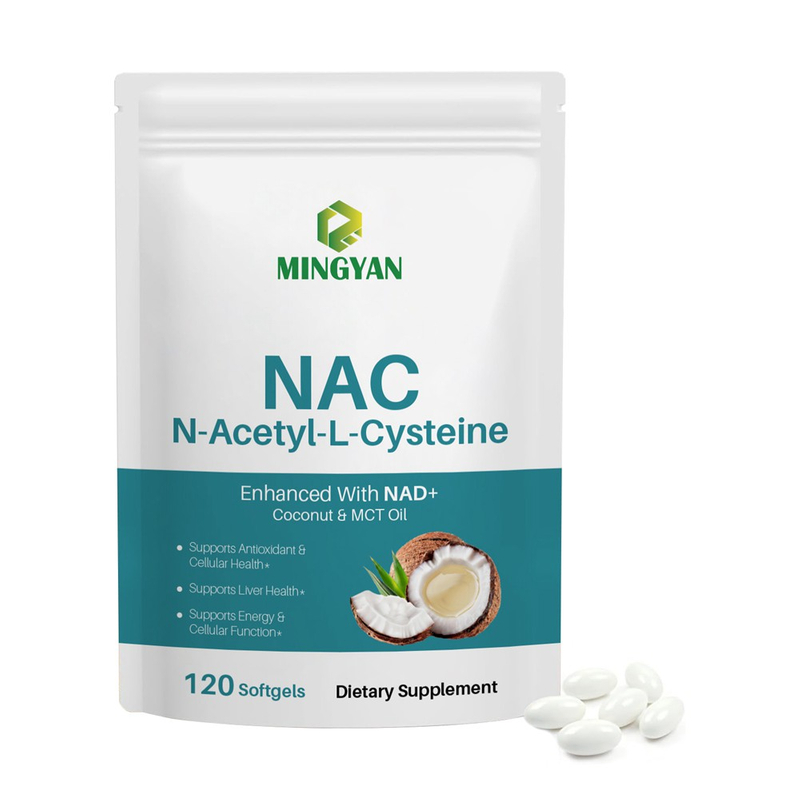
Packaging is not just a graphic-design choice. The final container-closure system should be evaluated with the formula and dosage form. MINGYAN's current NAC softgel is presented in a resealable stand-up pouch with 120 softgels, but a custom project should confirm its own count, packaging configuration, storage statement and stability support before commercialization.
A development sample can answer appearance, unit size, swallowability, packaging presentation and early handling questions. It cannot by itself establish long-term stability, routine commercial-scale performance or the release specification for future batches.
unit appearance and dimensions
packaging presentation
basic physical handling
whether the project concept is moving in the right direction
full shelf life
future-batch conformity
finished-product release criteria
commercial-scale process capability
The finished-product specification defines the product the manufacturing and quality systems are expected to deliver. Under 21 CFR Part 111, a manufacturer must establish product specifications for identity, purity, strength and composition and for limits on contaminants that may adulterate or lead to adulteration of the finished batch.
For a specific NAC project, additional physical or performance criteria may be established where they are relevant and supported—for example appearance, fill-weight controls, shell integrity, disintegration or other dosage-form-specific tests. Do not copy a generic checklist and assume every test belongs in every NAC specification.
What must be true for release? • Which test or examination verifies it? • What happens when a result does not meet the specification? • Which changes require review before implementation?
For a U.S.-market dietary supplement project, 21 CFR Part 111 requires a production and process-control system built around specifications, verification, records and quality-control review. One important detail is often oversimplified in sourcing articles: a supplier COA is not a substitute for every incoming test.
Dietary-ingredient identity: before use, the manufacturer must conduct at least one appropriate test or examination to verify the identity of any component that is a dietary ingredient, unless FDA grants the specific regulatory exemption described in §111.75.
Other applicable component specifications: the manufacturer may rely on a supplier COA only under the conditions in §111.75, including supplier qualification, documented reliability, appropriate COA content, periodic reconfirmation and quality-control review.
A brand does not necessarily need the manufacturer's entire proprietary manufacturing record in its possession. The commercial requirement is to define which batch-release and traceability documents you need, while confirming that the manufacturer maintains the required underlying records and quality-control system.
The finished formula and its container-closure system should be evaluated together. Packaging can affect exposure to moisture, oxygen, light and physical stress, so a container chosen only for shelf appearance can create a stability question later.
The dietary-supplement CGMP rule does not require an expiration, shelf or “best if used by” date. If a company chooses to place such a date on the label, FDA guidance states that the date should be supported by appropriate data.
For a custom NAC project, ask what stability work supports the actual commercial formula and packaging—not a different formula or temporary development container. The useful question is what data exist, what attributes are monitored and what remains to be established before a shelf-life statement is finalized.
NAC has an unusual U.S. regulatory history. FDA's position is that NAC is excluded from the statutory definition of dietary supplement because it was approved as a new drug before being marketed as a dietary supplement or food. FDA's August 2022 final guidance states an intent to exercise enforcement discretion for certain NAC-containing products labeled as dietary supplements that would otherwise be lawfully marketed and are not otherwise in violation of the FD&C Act.
The guidance does not convert NAC into an FDA-approved dietary ingredient and does not excuse unrelated labeling, claims, adulteration or CGMP issues. Before a U.S. launch, confirm the current FDA position and any retailer, marketplace or payment-provider requirements that affect your channel.
Under 21 CFR 101.36, the Supplement Facts panel declares serving information and dietary-ingredient amounts on the finished product. This is where Step 2 becomes visible: a 600 mg commercial concept has to be translated into a serving basis that the approved formula and production configuration actually deliver.
For qualifying structure/function and related claims, the marketer must have substantiation that the statement is truthful and not misleading, use the required disclaimer, and notify FDA no later than 30 days after first marketing the dietary supplement with the claim. Disease claims are a different category and should not be borrowed from acetylcysteine's drug uses and redirected to a supplement.
Unit price is the output of earlier decisions. Strength, dosage form, formula complexity, packaging, run quantity, testing and documentation scope all affect the commercial proposal. Quotations become comparable only when those assumptions are visible.
Scale-up should also be treated as a defined stage rather than an assumption. Ask what changes between development and commercial production, what must be reconfirmed, and which finished specifications will demonstrate that the scaled process remains acceptable.
A good NAC RFQ does not need to be long. It needs to make assumptions visible. Copy the framework below and replace each prompt with your project information.
Target market / channel: ______________________________
Product concept: ______________________________
NAC target and basis: □ per unit □ per serving □ open / formula reference
Preferred dosage form: □ softgel □ hard capsule □ request recommendation
Additional actives / exclusions: ______________________________
Serving target: ______________________________
Count / packaging: ______________________________
Claims intent for review: ______________________________
Testing / document requirements: ______________________________
First-order estimate: ______________________________
12-month volume range: ______________________________
Target launch window: ______________________________
Open questions: ______________________________
The “open questions” line matters. It tells the manufacturer where a recommendation is needed instead of forcing them to hide an assumption inside the quote.
For a project that begins from this reference product, the next question is not “is the formula 600 mg?” but “what finished configuration does your brand need?” That includes the approved NAC strength basis, additional ingredients, serving format, softgel count, shell requirements, packaging and destination-market label requirements.
For a project that begins from a different concept, we can instead start from the market target and evaluate the appropriate formula and dosage-form pathway through our custom supplement OEM/ODM process.
The terminology overlaps across the supplement industry, so the safest approach is to define scope rather than rely on the label alone. A project using an existing formula may need mainly branding, packaging and production support; a specification-led project may need manufacturing to an approved target; a development-led project may need formulation, feasibility and sampling before production. MINGYAN supports these different project scopes through its private label and OEM/ODM services.
Not automatically. A finished label needs a defined serving basis. MINGYAN's current public NAC product uses “600 mg formula option” wording, which does not by itself establish 600 mg per softgel or per labeled serving.
Neither is universally better. Softgels and hard capsules use different formulation and filling systems. The better pathway depends on active loading, companion ingredients, dosage-form feasibility, serving target, packaging, development priorities and commercial constraints.
Not as a general rule for the identity of a dietary ingredient under 21 CFR 111.75. The manufacturer must conduct at least one appropriate test or examination to verify the identity of any component that is a dietary ingredient unless FDA grants the regulatory exemption described in the rule. Reliance on a qualified supplier COA applies to other applicable component specifications under defined conditions.
The dietary-supplement CGMP rule does not require an expiration, shelf or “best if used by” date. If a company chooses to use one, FDA states that the date should be supported by appropriate data.
FDA's position is that NAC is excluded from the statutory dietary-supplement definition, while its August 2022 final guidance states an intent to exercise enforcement discretion for certain NAC-containing products labeled as dietary supplements that would otherwise be lawfully marketed and are not otherwise in violation of the FD&C Act. Enforcement discretion is not approval. Brands should confirm the current position and channel-specific requirements before launch.
Send the destination market, NAC strength target and basis, preferred dosage form or whether you want a recommendation, additional ingredients, serving target, count and packaging, expected quantity, claims intent and any testing or documentation requirements. If some items are still open, state them as open questions rather than forcing an early assumption.
Tell us the target market, what “600 mg” is intended to mean, the dosage form you are considering and the expected volume. We can use that information to review the development path and identify the questions that need to be resolved before sampling and quotation.
Send Your NAC Project Brief →