Views: 0 Author: Site Editor Publish Time: 2026-09-04 Origin: Site
NAC 600 mg is a labeled amount of N-acetyl-L-cysteine, a cysteine source the body can use in glutathione synthesis.
NAC stands for N-acetyl-L-cysteine, an acetylated form of the amino acid L-cysteine. In supplement labeling, the “600 mg” figure describes quantity. It does not, by itself, tell you how many capsules or softgels make up a serving, how much total fill is inside each unit, or how the finished dosage form is built.
On a U.S. Supplement Facts panel, dietary ingredients are declared with an amount per serving. That makes the serving size the first number to check. A product can use one unit, two units, or another defined quantity as a serving, so a front-label “600 mg” statement should never be assumed to mean 600 mg in every individual capsule or softgel.
People generally choose NAC supplements because NAC provides cysteine that can participate in the body’s normal glutathione-production pathway. Glutathione is produced within the body and plays an important role in cellular antioxidant defense and redox balance.
That biochemical role is different from saying that a 600 mg NAC supplement prevents or treats a specific health condition. A mechanism can be well established while the clinical effects of supplementation still vary by population, amount used, study duration, health status, and measured outcome.
NAC is best described as a cysteine source associated with glutathione synthesis and normal antioxidant processes. That is different from presenting it as a treatment, cure, or guaranteed outcome for a particular disease.
Glutathione is made from glutamate, cysteine, and glycine. Because cysteine availability can influence glutathione synthesis, NAC is commonly described as a glutathione precursor.
This pathway explains why NAC and glutathione are discussed together, but it does not guarantee that every person will experience the same change in glutathione status, biomarkers, or health outcomes after taking an NAC supplement.
NAC has been studied in many different settings, but the existence of research does not mean every study supports a consumer supplement claim. Human trials can differ substantially in population, NAC amount, study duration, baseline health status, other treatments, and measured endpoints.
| Statement type | How to read it |
|---|---|
| Biochemical mechanism | NAC contributes cysteine used in glutathione synthesis. |
| Human study result | Interpret it in the exact study population, dose, duration, and endpoint. |
| Disease-treatment claim | Do not transfer prescription-drug indications to a product marketed as a dietary supplement. |
A result observed in a clinical population should not automatically be generalized to healthy adults, and a change in a laboratory marker should not automatically be described as proof of a clinical benefit. When evaluating NAC information, look at who was studied, what form and amount were used, how long the study lasted, and what outcome was actually measured.
NAC and acetylcysteine refer to the same chemical substance, but products containing it can sit in very different regulatory and use contexts.
Consumer labeling and claims must follow the rules applicable to the product being marketed. Drug indications must not be borrowed for supplement marketing.
Approved drug products have defined medical indications and clinical dosing instructions tied to those products.
FDA’s August 2022 Final Guidance: Policy Regarding N-acetyl-L-cysteine states that FDA considers NAC excluded from the statutory definition of a dietary supplement under the drug-preclusion provision of the Federal Food, Drug, and Cosmetic Act.
FDA’s final guidance describes an enforcement-discretion policy for certain NAC-containing products that would otherwise be lawfully marketed dietary supplements if not for NAC’s exclusion. Enforcement discretion is not FDA approval and does not itself change NAC’s statutory status.
The label tells you much more than the front-panel “600 mg” statement. The most useful approach is to read it in a fixed sequence.
A supplement label cannot account for every person’s medications, health history, or individual circumstances. People who take prescription medications, are pregnant or breastfeeding, have an ongoing medical condition, are preparing for surgery, or have previously experienced adverse reactions to supplements should discuss NAC use with a qualified clinician or pharmacist.
If a product causes an unexpected reaction, professional guidance is more appropriate than changing the amount on your own. Product-specific directions and individualized medical advice should take priority over generalized dosing suggestions found online.
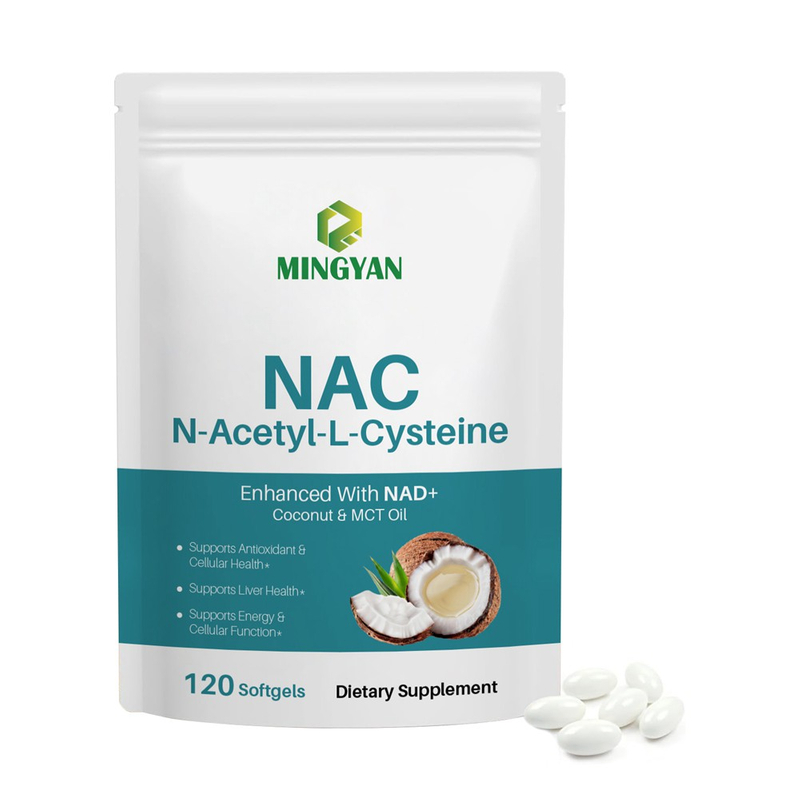
NAC can be presented in different dosage forms, but the formulation requirements are not the same. Hard two-piece capsules are commonly associated with powder or granule fills. Softgels are designed around a compatible liquid, solution, suspension, dispersion, or semisolid fill enclosed within a sealed shell.
| Decision point | Softgel | Hard two-piece capsule |
|---|---|---|
| Typical fill | Liquid, solution, suspension, dispersion, or suitable semisolid systems | Usually powders or granules |
| Key development question | Whether the fill remains uniform, stable, and compatible with the shell | Whether powder volume, density, flow, and loading fit the selected capsule size |
| What 600 mg does not define | Final fill weight, shell size, or units per serving | Final blend weight, capsule size, or units per serving |
An oil-based softgel does not automatically mean every active ingredient is dissolved in the oil. Depending on the finished formulation, an active may be dissolved, dispersed, or suspended, so physical state, uniformity, viscosity, shell compatibility, and stability must be evaluated for the actual commercial formula.
Two products can both display “NAC 600 mg” and still differ substantially in serving configuration, dosage form, other ingredients, packaging, and product documentation.
Serving size and amount per serving
Other ingredients and dosage form
Directions, cautions, and storage
Whether marketing claims match the label
Target strength and serving configuration
Dosage form and complete formula
Packaging and label requirements
Approved finished-product specification
Brands developing a 600 mg concept can review our NAC 600 mg sourcing guide for a deeper look at specification and manufacturing decisions, or compare the formulation paths in our NAC capsule vs softgel guide.
No. The amount declared in Supplement Facts is based on the labeled serving. A serving may consist of one unit or multiple units. Check both Serving Size and the NAC amount before assuming the number applies to each individual capsule or softgel.
NAC provides cysteine that the body can use in glutathione synthesis. Glutathione participates in normal cellular antioxidant defense. This biochemical role should be distinguished from claims that supplementation produces a guaranteed clinical outcome.
The chemical substance is acetylcysteine, but the regulatory context, formulation, claims, directions, and intended use can differ. Approved prescription-drug indications should not be treated as benefits of a product marketed as a dietary supplement.
FDA’s August 2022 final guidance states that the agency considers NAC excluded from the statutory definition of a dietary supplement under the drug-preclusion provision and describes an enforcement-discretion policy for certain NAC-containing products. Enforcement discretion is not FDA approval and does not itself change NAC’s statutory status.
Softgels can be used for appropriately developed liquid, solution, suspension, dispersion, or similar fill systems. For an oil-based NAC concept, the manufacturer must evaluate how each active exists in the fill, whether the system remains uniform, and whether it is compatible with the shell.
Check Serving Size, the NAC amount in Supplement Facts, directions, cautions, Other Ingredients, dosage form, and storage information. Do not rely on a front-panel “600 mg” statement by itself.
NAC 600 mg is easiest to understand by separating three questions: what NAC is, what the 600 mg amount refers to, and what claims are appropriate for the product being discussed.
NAC provides cysteine that the body can use in glutathione synthesis and normal antioxidant processes. The 600 mg figure should be interpreted on the serving basis shown in Supplement Facts rather than assumed to mean 600 mg in every individual unit.
Prescription acetylcysteine has approved medical uses, but those drug indications should not be transferred to NAC supplement marketing. In the United States, FDA’s August 2022 final guidance describes an enforcement-discretion policy for certain NAC-containing products while maintaining its stated position under the drug-preclusion provision.
For consumers, the practical next step is to read the complete label rather than judge a product by the front-panel number alone. For supplement brands, it is to define the formula, serving basis, dosage form, label, and approved specification before turning “NAC 600 mg” into a finished commercial product.
MINGYAN supports private label, OEM, and ODM supplement projects from formula review and sampling to packaging and finished-product production.
Explore OEM/ODM Solutions →